Most of us think about light only when it’s too bright, too dim, or shining straight into our eyes while we’re trying to fall asleep. We rarely stop to consider that light is also one of the most powerful timing signals our bodies receive every day.
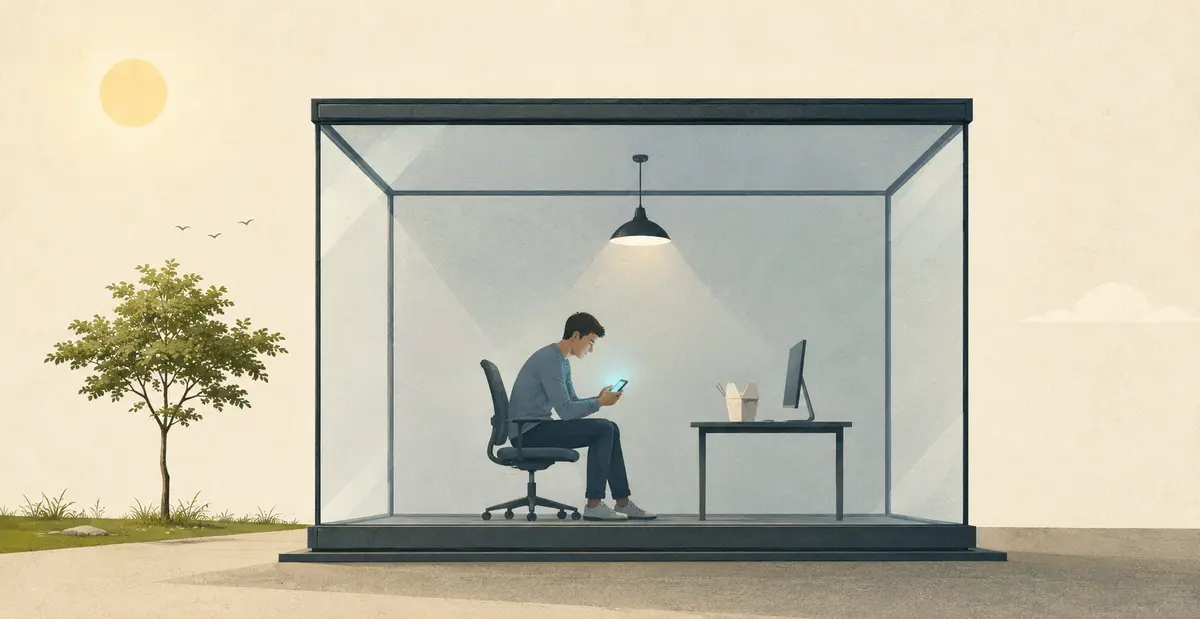
Yet in our modern indoor world—dim days spent under office lights and bright evenings filled with screens and indoor lights—that timing signal has quietly become blurred. The result is often the same frustrating pattern: you get “enough” sleep but still wake up groggy, struggle to fall asleep at a reasonable hour, or feel oddly out of sync even when your schedule looks fine on paper.
This article explains exactly how artificial light creates that mismatch, why it affects far more than just blue light from screens, and—most importantly—how small, realistic changes to your daily light environment can restore a clearer day-night rhythm. You’ll finish with a practical understanding of circadian timing and three simple fixes you can use without turning your life upside down.
Light Is a Signal to the Body
Light does more than help us see. It also helps tell the body what time it is.
Human biology runs on timing. Sleep and wakefulness are the most obvious examples, but they are only part of the picture. Body temperature, alertness, digestion, appetite, hormone release, mood, immune activity, and recovery all follow daily rhythms. These patterns are not random. They are coordinated by the circadian system: the body’s internal timing network.
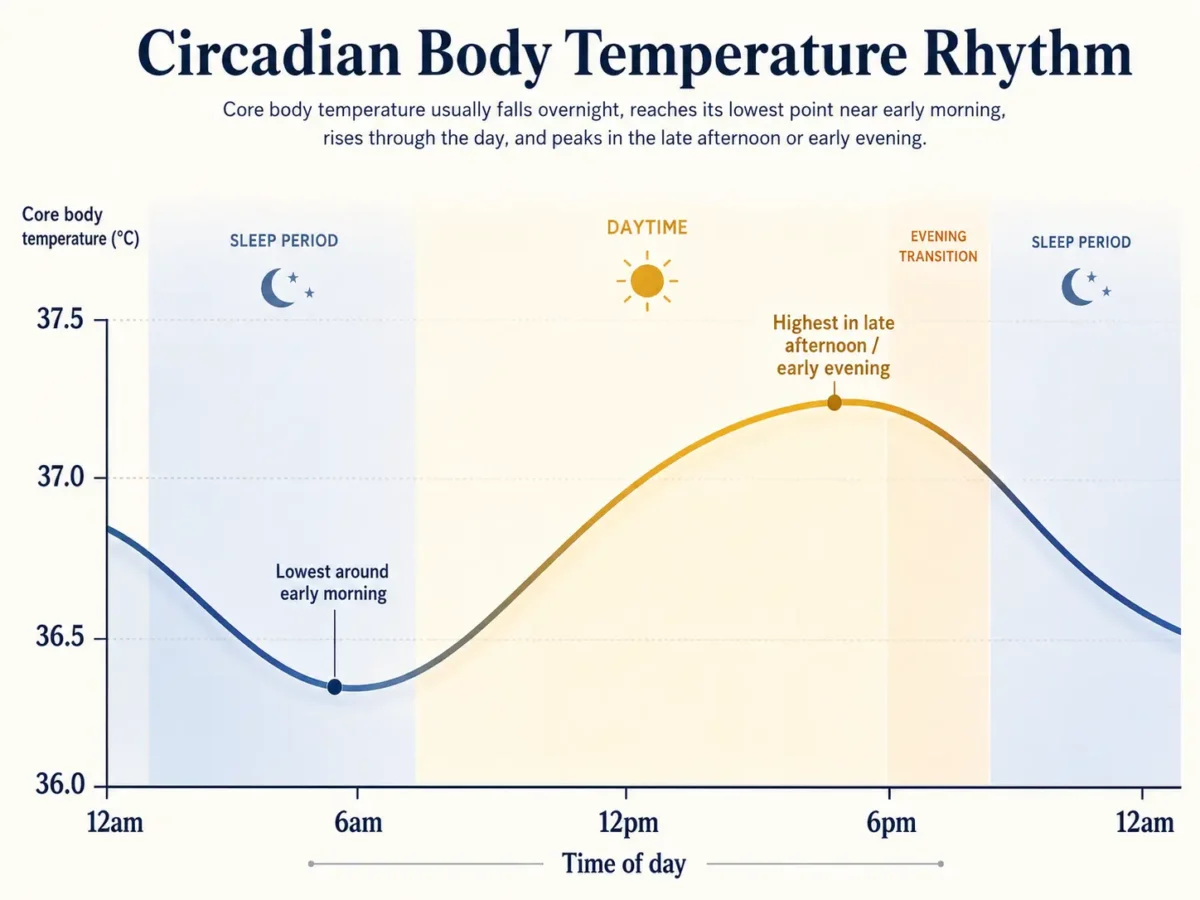
Circadian rhythm is often described as the “body clock,” which is useful as a starting point, but slightly incomplete. The brain does have a central clock, called the suprachiasmatic nucleus, but timing signals also reach tissues throughout the body. The liver, pancreas, gut, muscles, fat cells, immune system, and other organs all have rhythms of their own. In a healthy rhythm, these systems are not all doing the same thing at the same time. They are working in sequence.
This is why you can feel strange after jet lag, an all-nighter, late meals, or a badly timed sleep schedule. The body is not only responding to how many hours you have been awake. It is also responding to where it thinks you are in the day. There is a difference between being tired because you need sleep and being out of sync because your internal timing has been pushed around.
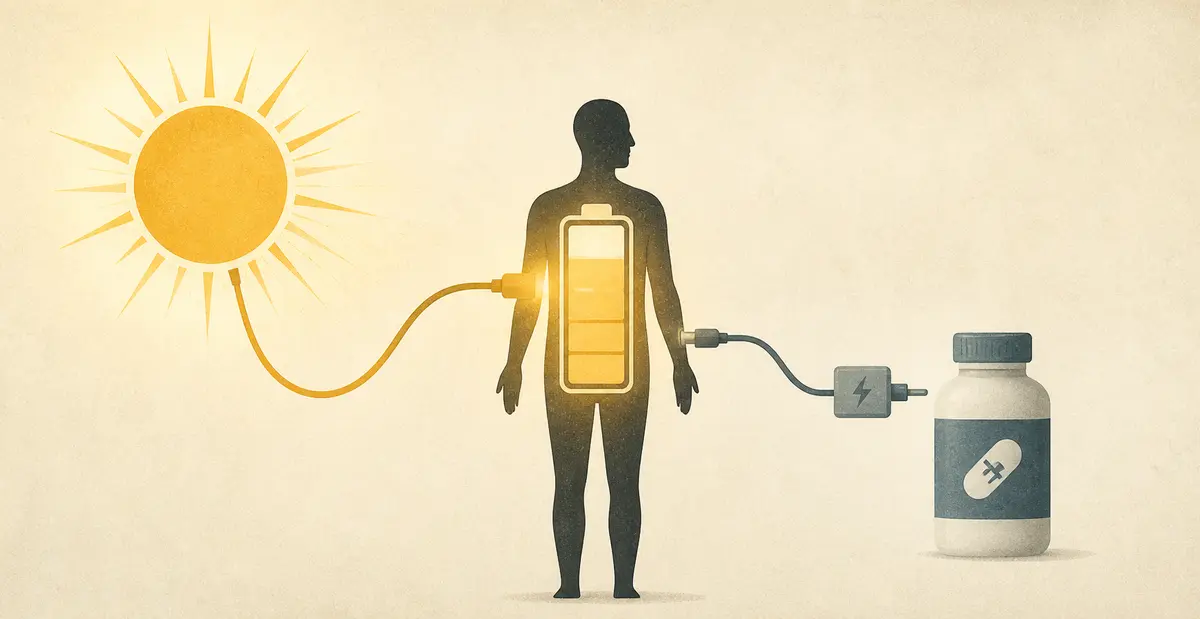
Light is one of the strongest cues the circadian system receives. Some cells in the retina are involved in ordinary vision, but others help send light information to the brain’s central clock. These pathways are especially important for the non-visual effects of light: melatonin timing, alertness, sleep-wake rhythm, and the body’s sense of biological day and night.
That is why light should be understood as a health input as much as diet, exercise, or sleep. A bright environment in the morning does not send the same message as bright light late at night. Darkness in the evening does not mean the same thing as darkness in the middle of the day. The body reads light in context, and timing changes the message the body and brain receive.
This is also where modern life becomes interesting. The problem is not that artificial light exists, or that every screen is harmful. The deeper issue is whether our light environment is giving our bodies clear timing signals. Circadian rhythm is not just about getting enough hours in bed—it is about whether the body knows when to be awake, when to wind down, when to digest, when to repair, and when to sleep.
The Modern Light Mismatch Most People Never Notice
For most of human history, light followed a pattern the body could easily read. Days were bright, evenings gradually became dim, and nights were dark. Modern life has changed that pattern without changing the biology that depends on it.
The mismatch now works in both directions. Many people spend most of the day indoors, where light may be bright enough for vision but weak as a circadian signal. Then, after sunset, homes stay lit, screens move close to the face, bathrooms and kitchens are flooded with overhead light, and bedrooms are often interrupted by LEDs, hallway light, streetlight, or a television left on in the background.
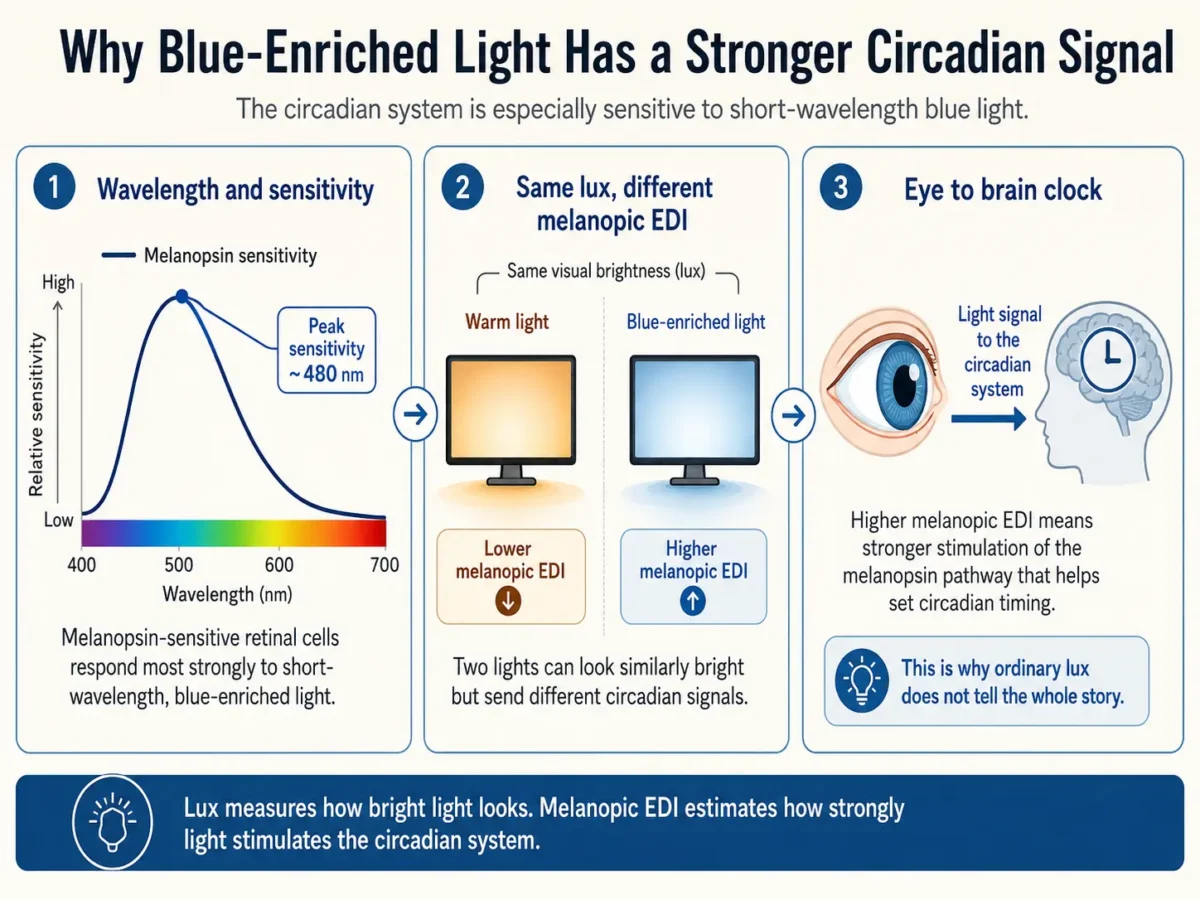
This is where ordinary light measurements can be misleading. Traditional lux measures how bright light appears to the human eye. While useful, the body does not only use light for vision.
The eye also contains melanopsin-sensitive retinal cells that help send light information to the brain’s circadian system. These cells are especially responsive to shorter-wavelength, blue-enriched light, which means two lights can look similarly bright while having different biological effects.
To overcome this issue, scientists use a measure called melanopic equivalent daylight illuminance, or melanopic EDI, to estimate this more directly. In simple terms, melanopic EDI describes how strongly a light source stimulates the melanopsin-based system compared with natural daylight, making it more relevant to circadian timing than ordinary lux alone.
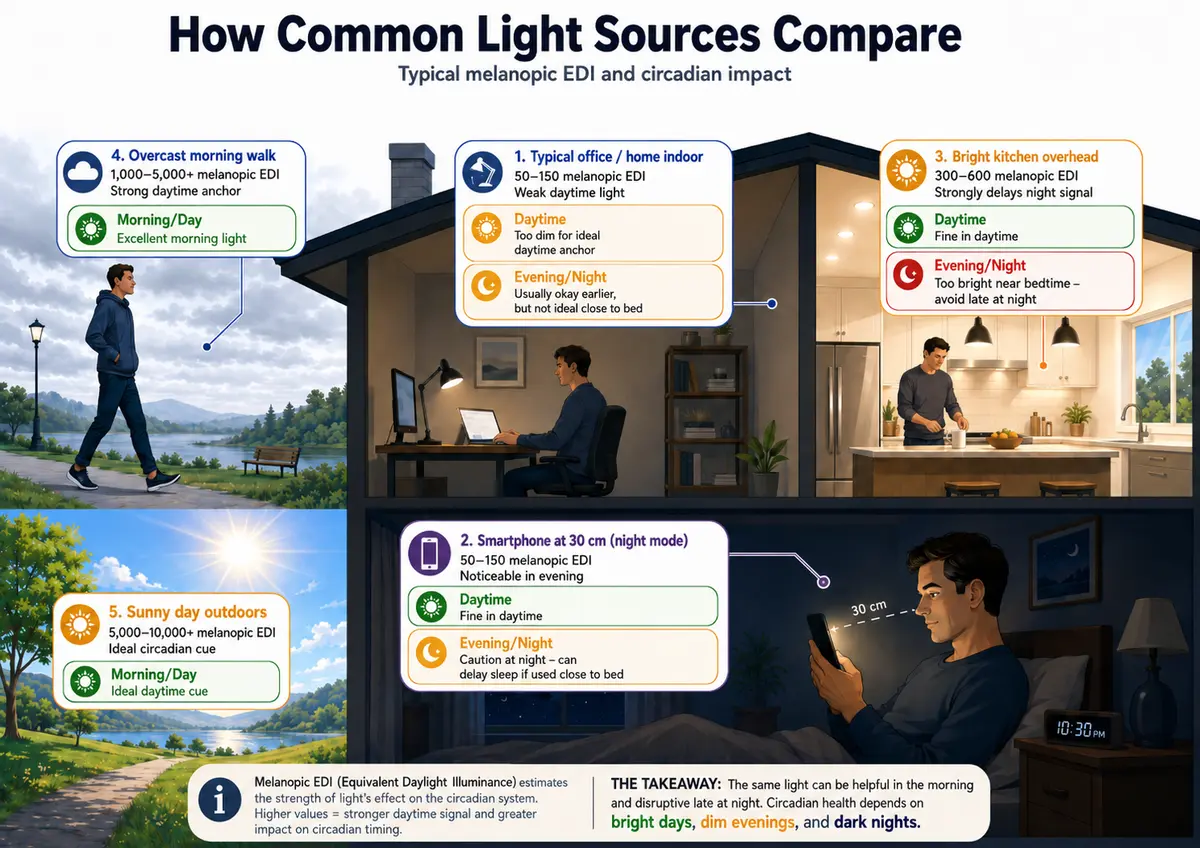
Current circadian-light guidance suggests that healthy adults generally benefit from at least 250 melanopic EDI during the day, no more than about 10 in the final three hours before bed, and around 1 or less during sleep. For reference, the table below compares common light sources so you can see why indoor light may be too weak during the day but too strong at night.
| Light source or setting | Typical melanopic EDI at the eye | Best understood as | Practical takeaway |
| Dark bedroom at night | 0–1 | Ideal sleep signal | Keep the bedroom as dark as practical |
| Dim warm lamp / low night light | 1–10 | Low evening/night signal | Better than overhead light if you need light late |
| TV across the room | 10–50 | Moderate evening signal | Usually less intense than a close screen, but still adds light and stimulation |
| Smartphone at 30 cm, dim/night mode | 50–150 | Noticeable close-range signal | More relevant at night because it is close to the eyes |
| Typical home or office lighting | 50–150 | Weak daytime signal | Often enough to see, but not a strong daytime anchor |
| Bright kitchen or bathroom overhead | 300–600 | Strong evening/night signal | Fine in daytime, but too bright close to bed |
| Overcast outdoor daylight | 1,000–5,000+ | Strong daytime anchor | A cloudy walk can still be powerful for circadian rhythm |
| Sunny outdoor daylight | 5,000–10,000+ | Ideal daytime cue | The clearest daytime signal for the body clock |
The useful point here is that light is not good or bad on its own. Timing changes what the same light means to the body.
A bright kitchen or bathroom light might be helpful in the morning. If it delivers around 300–600 melanopic EDI, it can act as a strong daytime signal. But late in the evening, that same light is doing something very different. When current guidance suggests staying below about 10 melanopic EDI in the final three hours before bed, a bright overhead light at 10 p.m. may be far more stimulating than it feels.
The opposite problem happens during the day. A typical home office or indoor workspace may sit around 50–150 melanopic EDI. That can be bright enough to read, cook, or work at a screen, but still fall short of the 250 melanopic EDI daytime target used in circadian-light guidance. So a room can feel normal to your eyes while still giving your body a fairly weak daytime signal.
Outdoor light is in a different category. Even an overcast morning walk can provide roughly 1,000–5,000+ melanopic EDI, while sunny outdoor light can be higher again. The exact number depends on weather, shade, season, and where your eyes are facing, but the pattern is clear: modern life often gives us a dimmer version of day indoors, followed by a brighter version of evening than the body expects.

Get Your Free Book!
Enter your email to get the free book and occasional updates from The New Health Order.
How Evening Light Delays Your Biological Night
Evening light arrives at the point in the day when the body should be moving toward biological night.
One of the clearest markers of that transition is melatonin. It is often described as a sleep hormone, but it is better understood as a darkness signal. As natural light fades, melatonin begins to rise, helping the body shift away from daytime alertness and toward sleep.
This is why expert recommendations now separate daytime, evening, and nighttime light targets. The 2022 consensus suggests keeping light exposure below about 10 melanopic EDI in the final three hours before bed, compared with at least 250 melanopic EDI during the day. The basic idea is that evening should become biologically dim, not just slightly less bright than daytime.
Controlled research supports this. In a study of 116 healthy adults, researchers found that ordinary room light before bedtime — less than 200 photopic lux — delayed melatonin onset in 99% of participants and shortened melatonin duration by about 90 minutes compared with dim light. Room light during usual sleep hours also suppressed melatonin by more than 50% in most trials.
The problem is amplified when a normal evening includes several light exposures that barely register as unusual: cooking under bright recessed lights, brushing your teeth under bathroom vanity lights, watching television, then scrolling in bed. None of these needs to be dramatic on its own—the combined signal is the issue.
The effect also depends on timing, brightness, duration, distance from the eyes, spectrum, and daytime light history. A lamp across the room is not the same as a phone held close to the face. A brief exposure is not the same as an hour in a bright room. The larger point is that repeated evening light can delay or weaken the body’s night signal, especially when it is bright, prolonged, or close to the eyes.
How Screens Disrupt Sleep (It’s Not Just the Light)
Screens can disrupt sleep through light, but light is only part of the problem.
A phone is not just a light source. It is a source of messages, work, entertainment, stress, novelty, comparison, and one more thing to check before bed. That makes screens different from ordinary evening lighting. They can affect sleep biologically, by exposing the eyes to light at the wrong time, and behaviorally, by keeping the mind engaged when the day should be winding down.
The light effect is real and measurable. In a controlled study, Chang and colleagues compared reading from a light-emitting e-reader before bed with reading a printed book. The e-reader suppressed melatonin, delayed circadian timing, increased the time it took to fall asleep, reduced evening sleepiness, reduced REM sleep, and left participants less alert the next morning.
The study was small and involved several hours of evening exposure, so it should not be read as one quick phone check ruins sleep, but it does show that prolonged use of a light-emitting device before bed can push sleep biology in the wrong direction.
In real life, the screen itself is only half the story. Most people are not lying in bed staring calmly at a blank rectangle of light. They are checking messages, watching clips, reading news, replying to work, scrolling through comments, or following one more link that turns into ten. Even when the screen is dimmed, the content can keep the mind engaged long after the body should be winding down.
For many people, the bigger problem is not that the device directly prevents sleep. It simply keeps the evening going. Bedtime moves from 10:30 to 11:15, then to midnight, not because the person made a deliberate decision to sleep less, but because the phone removed the natural stopping point. Over time, that can mean shorter sleep, later sleep timing, and harder mornings.
This pattern is especially clear in children and adolescents, where bedtime access to portable screens is consistently associated with shorter sleep duration, poorer sleep quality, and more daytime sleepiness. While most of that evidence is observational, so it cannot prove screens are the only cause, it still fits the real-world pattern: devices in the sleep environment make sleep easier to postpone.
The goal does not need to be no screens after sunset either. For most people, that is unrealistic. A better target is to protect the final part of the evening. Dim the screen, use warmer or redder settings if they help, keep the device farther from your eyes, and avoid the kind of content that pulls you in when you should be winding down. Most of all, try not to let the phone in bed become the default way the day ends.
Screens are not uniquely dangerous, but they are very good at extending the day. They bring light, stimulation, and endless optional activity into the exact window when the body should be letting go of both.
Is Blue Light Really the Problem?
Blue light is part of the story, but it is rarely the whole story.
The melanopsin cells that set circadian timing are most sensitive to short-wavelength (blue-enriched) light. That is why evening blue light can suppress melatonin more efficiently than equally bright longer-wavelength light. Melanopic EDI exists precisely because ordinary lux measurements miss this.
Yet “blue light is bad” oversimplifies important biology. A bright warm-white bathroom fixture at 11 p.m. can still deliver plenty of melanopic EDI and delay your clock. A dim blue-enriched phone screen used for 10 minutes is usually less disruptive than two hours of moderately bright warm light.
Blue-light filters, night modes, and glasses can reduce the signal, but a 2023 Cochrane review of randomized trials found they probably make little or no meaningful difference to eye strain or sleep quality in real-world use.
So it is worth being careful with blue light, but not getting stuck on it. Blue-enriched light can contribute to the evening mismatch, especially from bright or close-range screens, but it is only one part of the exposure. Timing, brightness, duration, distance from the eyes, and your recent light history all shape the circadian signal.
Why Morning Light Is the Strongest Anchor
Morning light matters just as much as evening light because circadian rhythm is shaped by the whole day’s light pattern, not only what happens before bed. The signal you give your body near the start of the day helps set the rhythm for what comes later.
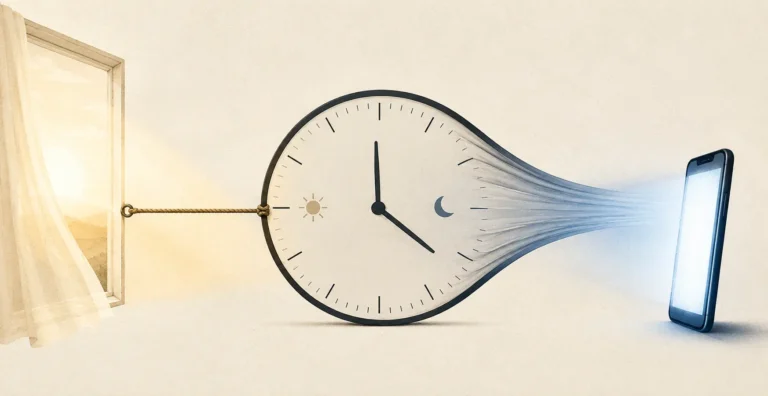
Light in the morning helps anchor the body clock. It tells the brain that daytime has begun, supports alertness, and helps set the timing for when the body should start moving toward sleep later on. This is why the same light can have different effects depending on when it arrives during the day. Evening light can push the body later, while morning light tends to pull the rhythm earlier and reinforce the day-night cycle.
Outdoor light is hard to replace indoors because even a bright-looking room is usually weak compared with daylight. This is why the 2022 expert consensus recommendations suggest at least 250 melanopic EDI during the day: many indoor environments are bright enough for vision but not especially strong as a circadian anchor.
The effect becomes clearer in natural light-dark studies. In camping research led by Kenneth Wright’s group, people exposed to outdoor daylight and dark nights shifted their melatonin timing earlier compared with their usual modern light environment. After just one weekend, participants’ melatonin rhythms shifted almost an hour earlier, even without changing bedtime.
For most people, the practical version is simple. Morning light does not need to be complicated. A short walk outside, daylight during the commute, breakfast near a bright window, or stepping out during the first part of the day can all help strengthen the signal. Outdoor light is best because it is usually far stronger than indoor light, even when the weather is cloudy.
Why Light Timing Matters Beyond Sleep
Sleep is where mistimed light is easiest to notice, but circadian rhythm does not stop at sleep. The same timing system that helps regulate when you feel awake or tired also helps coordinate metabolism, appetite, hormone rhythms, body temperature, mood, cognition, and recovery. This is why a disrupted light environment can matter even when someone is technically getting enough hours in bed.
The strongest evidence is still around light’s effects on circadian timing, melatonin, alertness, and sleep. That is the foundation. From there, the wider health effects become more complex, because light rarely acts alone. Late nights often come with later meals, more screen use, less morning daylight, inconsistent sleep schedules, stress, and less recovery. But those confounders do not make the circadian system irrelevant. They are part of the same modern pattern.
Metabolism is one example. The body does not handle food, glucose, and insulin the same way at every hour. Circadian biology helps organize these rhythms, which is one reason late eating, short sleep, and irregular schedules often cluster with poorer metabolic health. Light can contribute indirectly by shifting sleep later, weakening the night signal, and making late-night activity feel more normal.
A large objective-light study of more than 86,000 UK Biobank participants found that higher nighttime light exposure was associated with greater risk of several psychiatric outcomes, while higher daytime light exposure was generally associated with lower risk.
For example, high nighttime light was associated with about a 30% higher risk of depression, while high daytime light was associated with about a 20% lower risk. This kind of study cannot prove that light exposure alone caused the difference, but it fits the broader pattern: brighter days and darker nights appear to be healthier signals than dim days and bright nights.
Shift work gives us the more extreme version of the same principle. People working nights or rotating schedules often have sleep, light exposure, food timing, and activity pushed out of alignment. That is much more disruptive than ordinary evening screen use, so the comparison should not be exaggerated. But it does show that when circadian timing is repeatedly disturbed, the effects can reach far beyond feeling tired.
Your Realistic Light Routine
After all the detail, the practical message is surprisingly simple. You do not need to live by candlelight, avoid every LED, or treat screens as if they are toxic. Artificial light made modern life possible. The goal is not to reject it, but to use it with better timing.
A healthier light routine is built around contrast: stronger light during the day, softer light in the evening, and real darkness during sleep. That rhythm does not need to be perfect to be useful. It just needs to be clearer than the one most modern homes create by default.
Use this three-anchor routine as a starting point:
Day Anchor (first 1–2 hours after waking)
Get outside or next to the brightest window available for 20–30 minutes. Even on an overcast day this usually delivers far more melanopic EDI than any indoor setup. A short walk, coffee on the porch, or commuting without sunglasses does the job. For more on natural light and metabolic health, see our sunlight article. (your-sunlight-article-url)
Evening Dim-Down (last 3 hours before bed)
Treat the final stretch of the day as a transition, not an extension of daytime. Switch overhead lights off and use warmer, lower lamps. Drop screen brightness to 30–50% and enable night/warm/red modes (many phones have an option to engage a “red light” mode). Keep devices at arm’s length rather than 8 inches from your face.
Night Blackout (bedroom)
Make the room dark enough that you cannot see your hand in front of your face. Blackout curtains or blinds, tape over charging LEDs, eye mask if needed. If you get up at night, use a red or very dim motion light—never a bright overhead or phone screen.
These three anchors are enough for most people to feel a difference within days. They are flexible, low-effort, and far more effective than any single gadget or supplement.
Final Thoughts
The modern light environment rarely feels dramatic, yet it quietly shifts the body’s most fundamental timing system. By giving ourselves stronger daytime light, a gentler evening wind-down, and true darkness at night, we restore the clear day-night contrast our biology expects.
Most people notice the difference in sleep quality and morning alertness within a week or two — often with nothing more complicated than the three anchors outlined above.
Light is not the only factor that shapes circadian health, but it is one of the most controllable. Small, consistent changes here tend to make every other habit (sleep schedule, meal timing, movement) easier to maintain.
FAQs
Does blue light affect sleep?
Yes, blue-enriched light can affect sleep because the circadian system is especially sensitive to shorter-wavelength light. But blue light is not the whole story. Brightness, timing, duration, distance from the eyes and recent daytime light exposure all shape the effect. A bright room late at night may be more disruptive than a dim phone used briefly.
Are screens before bed bad for sleep?
Screens can affect sleep through light exposure, mental stimulation and delayed bedtime. The screen itself may suppress melatonin or delay circadian timing when used for long periods before bed, but the content also matters. Scrolling, work messages, news, social media and videos can keep the mind engaged when the body should be winding down.
Does morning light help circadian rhythm?
Yes. Morning light helps anchor the body clock by giving the brain a clear daytime signal. Outdoor light is usually much stronger than indoor light, even on cloudy days. Getting daylight early in the day can support alertness, reinforce circadian timing and help the body move toward sleep at a more appropriate time later.