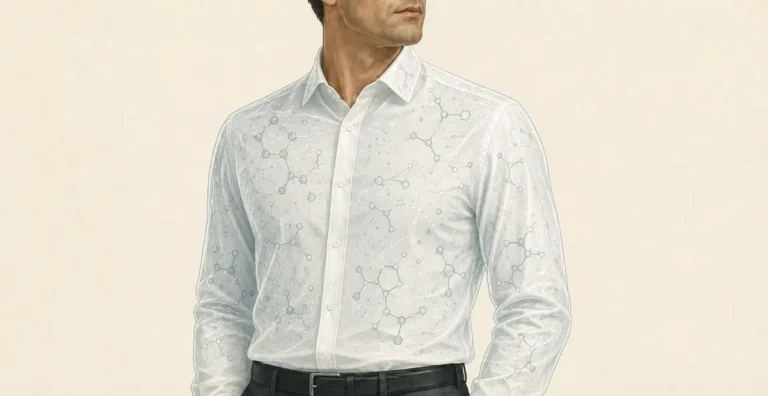
Dryer sheets may seem harmless enough. But they are designed to leave chemical residues on clothing, and scented versions also release fragrance compounds during drying. That makes it reasonable to ask whether something used week after week, for years, could carry a health cost.
The limited research done so far has not established that normal dryer-sheet use causes cancer or disrupts hormones. But these questions have also not been studied comprehensively enough—particularly over decades of repeated exposure—to dismiss them entirely.
What we do know is that some chemicals associated with dryer sheets have genuine biological effects at sufficient doses, while other concerns, such as skin irritation and fragrance-triggered respiratory symptoms, are much better documented.
In this article, we will look at what dryer sheets actually expose you to, how strong the cancer and hormone evidence really is, and whether the remaining uncertainty is enough reason to avoid a product whose benefits are mostly softer clothes, less static and fragrance.
What Chemicals Do Dryer Sheets Expose You To?
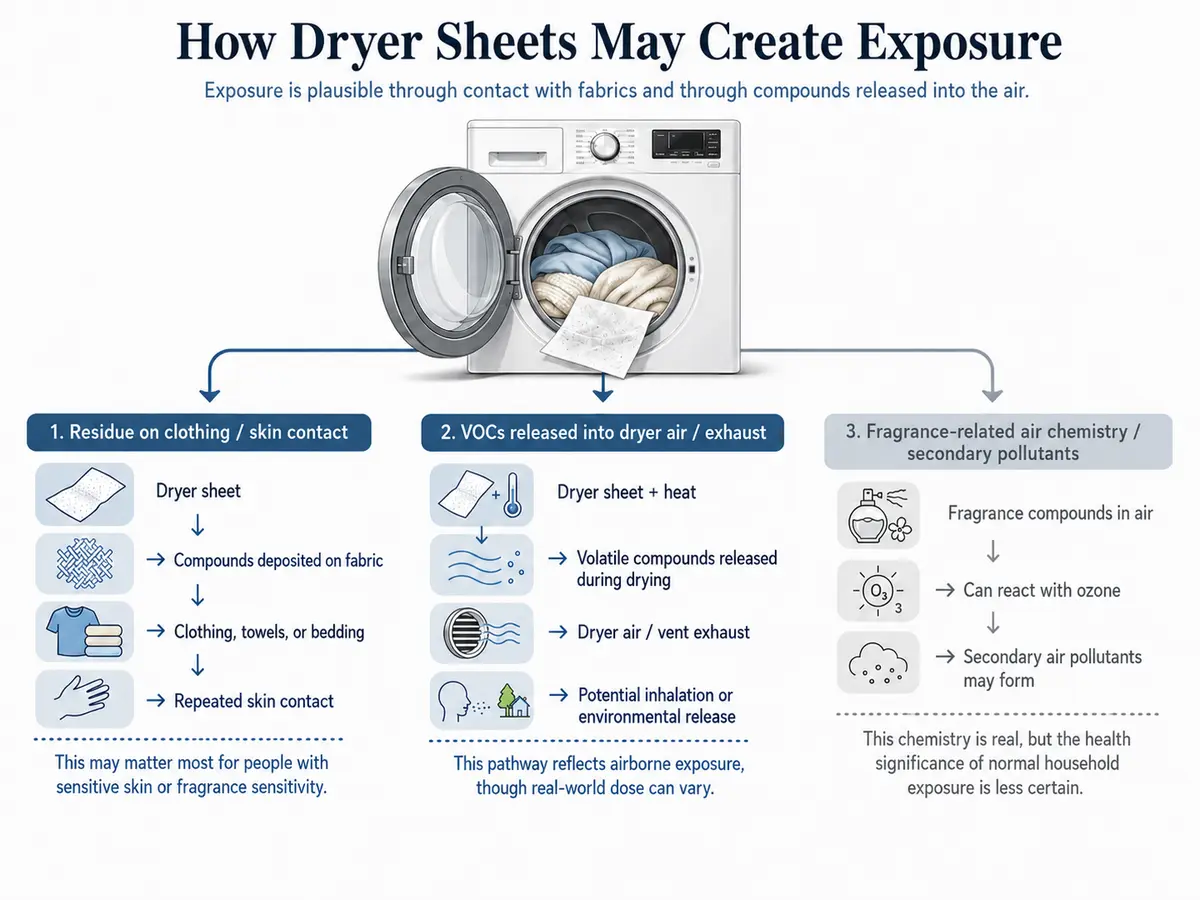
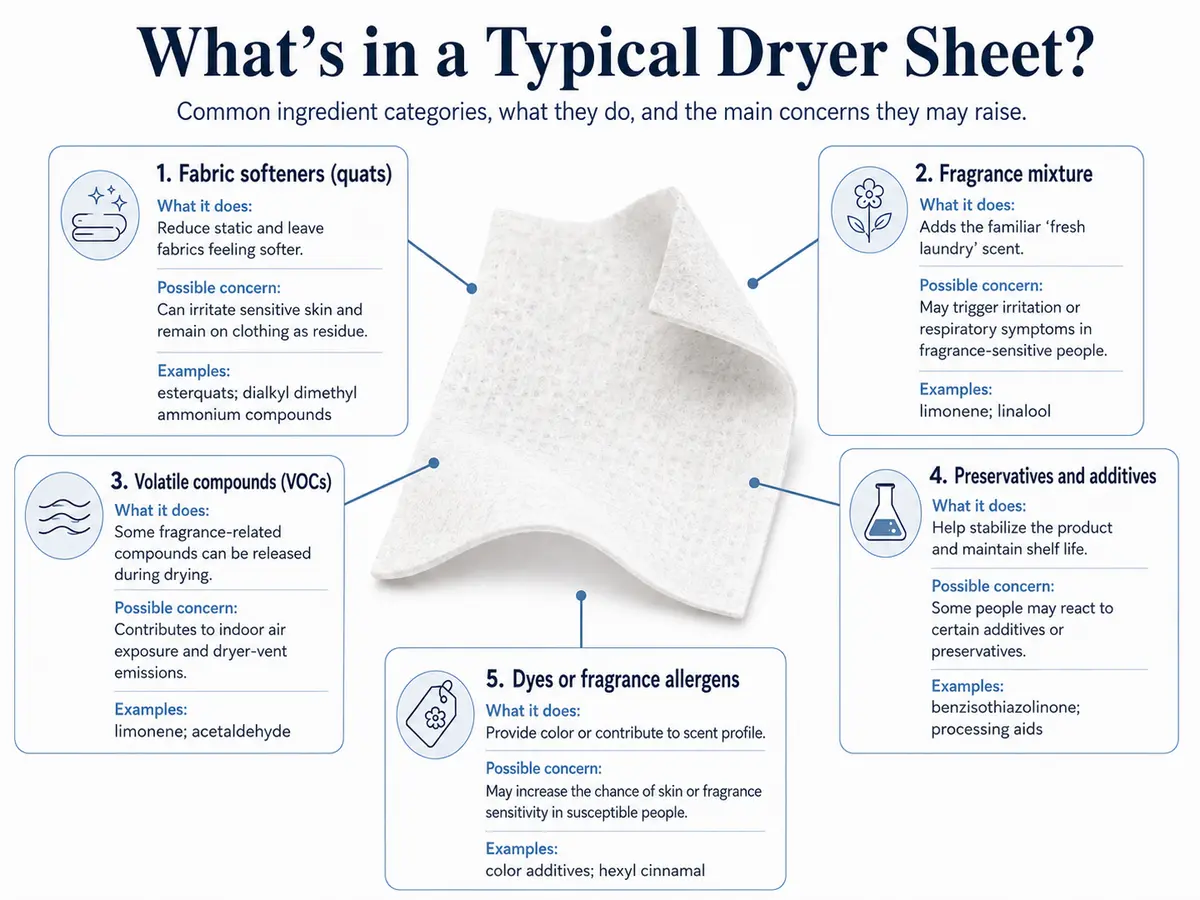
Dryer sheets are designed to leave something behind. As they heat and tumble, fabric-softening compounds transfer onto clothing, while scented versions also leave fragrance. This means exposure can continue after the dryer stops, simply because the treated fabric sits against your skin for as long as you wear it.
The chemicals involved vary by product. Modern dryer sheets may contain quaternary ammonium-based softeners, or “quats,” while fragranced products contain mixtures of volatile compounds (VOCs). Some testing has also detected chemicals such as phthalates (potential hormone disrupters) in some dryer sheets.
Heating adds another possible route of exposure. Fragranced laundry products can release VOCs into dryer exhaust vents, and some fragrance compounds can react in the air to form additional pollutants.
While this isn’t proof of harm, it does show is that the exposure is real, and that some of the chemicals involved are biologically active at sufficient doses. The unanswered question is how much normal use contributes to that exposure over time.
So rather than asking vague questions such as whether dryer sheets are “toxic,” it is more useful to look at the specific concerns—cancer, hormone disruption, VOC exposure and more immediate reactions such as skin or respiratory irritation—and see what the evidence can actually tell us.
| Concern | What is supported | What remains uncertain | Overall interpretation |
| Chemical exposure | Residues and airborne emissions can occur | Actual absorbed dose varies by product and use | Exposure is established |
| Skin irritation | Fragrances and some ingredients can irritate susceptible skin | How common this is specifically from dryer sheets | Better-supported short-term concern |
| Respiratory symptoms | Fragrance exposure can trigger symptoms in susceptible people | Real-world dose and individual sensitivity vary | Better supported in susceptible people |
| Hormone disruption | Some associated chemicals have endocrine activity under certain conditions | Normal dryer-sheet use has not been shown to disrupt hormones in humans | Biological concern; human outcome uncertain |
| Cancer | Some detected compounds have hazardous properties | Ordinary dryer-sheet use has not been shown to increase cancer risk | Long-term outcome unestablished |
Do Dryer Sheets Cause Cancer?
There is no clear-cut evidence showing that normal dryer-sheet use causes cancer. But that does not mean the long-term risk has been fully ruled out.
The cancer concern is not completely out of nowhere. Some chemicals found around fragranced laundry products can cause cancer at sufficient exposure. Benzene is a known human carcinogen, and acetaldehyde has also raised cancer concerns.
In the most commonly cited dryer study, researchers detected more than 25 VOCs in dryer exhausts. They also tested the laundry products directly: the dryer sheet emitted acetaldehyde, although benzene was not detected directly from the sheet.
Interestingly, adding the dryer sheet did not increase benzene or acetaldehyde in the dryer exhaust, suggesting that the source of these emissions is more complicated than simply “the dryer sheet contains carcinogens.” Detergent, residues already in the machine, heating, and chemical reactions during drying may all contribute to some degree.
But there is another limitation that matters just as much: we do not have good long-term data showing how much additional exposure regular dryer-sheet use creates over years or decades.
This is important because cancer risk is not always about one large exposure. Think about sunlight: UV radiation does not accumulate in your body, but repeated exposure can repeatedly damage DNA, and over time some of that damage can contribute to skin cancer. A carcinogen can work in a similar way. The chemical may be cleared from the body, while the biological effects of repeated exposure accumulate. How much that matters depends on the dose, frequency and duration of exposure.
So the evidence does not justify saying that dryer sheets cause cancer. But it also does not justify treating the absence of demonstrated cancer cases as proof that repeated exposure is completely harmless.
The more accurate conclusion is that some relevant chemicals have genuine carcinogenic hazards, while the additional lifetime exposure created specifically by dryer sheets—and the cancer risk attached to it—remains poorly studied.
Get Your Free Book!
Enter your email to get the free book and occasional updates from The New Health Order.
Do Dryer Sheets Disrupt Hormones?
There is also no conclusive evidence showing that normal dryer-sheet use disrupts human hormones. But, as with cancer, the bigger limitation is that long-term exposure has not been studied especially well.
The concern is biologically plausible, however, because some chemicals historically detected in fragranced consumer products, including certain phthalates, can interfere with hormone signaling at sufficient exposure. A 2012 analysis of household products, for example, found several chemicals associated with endocrine disruption across fragranced products, including dryer sheets.
What that study could not tell us is how much of those chemicals actually entered the body from using a dryer sheet, or whether the resulting dose was high enough to alter hormone function.
A later biomonitoring study adds some useful context. Researchers measured phthalate metabolites in the urine of 94 adults and compared them with reported product use. Scented dryer-sheet use was not associated with higher levels of the main fragrance-related phthalate metabolite.
That is reassuring to a degree, but it is not the same as proving zero risk. Phthalates are generally cleared from the body relatively quickly, yet repeated daily exposure can keep replenishing them. So the relevant question is not only whether they accumulate, but whether dryer sheets contribute enough to someone’s overall exposure over months or years to matter biologically.
Quaternary ammonium compounds, or “quats,” raise a similar problem. Some quats have shown reproductive or other toxicological effects in experimental research, but the compounds used in disinfectants are not necessarily the same as the esterquat-type softeners used in dryer sheets, and their exposure levels can differ greatly.
So the most accurate conclusion is that hormone disruption from normal dryer-sheet use has not been demonstrated, but neither has long-term exposure been characterized well enough to dismiss the question entirely. Some of the chemicals involved have genuine endocrine concerns; what remains uncertain is whether dryer sheets contribute enough exposure to make a meaningful difference.
Our Modern Environment guide looks at this broader relationship between everyday exposures and health.
VOCs and Fragrance Exposure
Fragranced laundry products can release VOCs when they are heated. That sounds concerning, but VOC is a very broad label—it includes many different chemicals with very different effects. Some mainly act as irritants, while others can react in the air and form new compounds that may affect the respiratory system in their own right.
For example, limonene is commonly used to create citrus-like fragrance. By itself, it is not considered highly toxic at normal household exposure, but it can react with ozone to produce secondary pollutants including formaldehyde and ultrafine particles.
These are more concerning because inhaled irritants and very small particles have been shown to interact directly with the lining of the respiratory tract and, at sufficient exposure, contribute to inflammation and oxidative stress.
Fragrances have also been shown to change what comes out of the dryer. In one small household study, dryer-vent levels of d-limonene fell by an average of 79% after households switched from fragranced to fragrance-free laundry products.
How much of this translates into meaningful human harm is still uncertain. Most conventional dryers vent much of their exhaust outdoors, while fragrance can also remain on the clothing itself. Exposure therefore depends on the product, ventilation, dryer type and how often it is used.
What we can say with more confidence is that fragranced laundry adds an avoidable source of VOC exposure, and switching to fragrance-free products can reduce that exposure substantially. Whether the reduction meaningfully changes long-term health risk, however, has not yet been well established.
Health Effects We Know More About
While the long-term cancer and hormone questions remain uncertain, some shorter-term effects of dryer sheets are better established—particularly in people who already react to fragrance or have sensitive skin.
Skin Irritation and Eczema
Fragrance is a common contact allergen, and dryer sheets leave it directly on clothing that may sit against the skin for hours.
In one survey of some of the most popular textile-care products, fragrance or essential oils were identified as allergens in 75% of the dryer sheets examined. While this won’t have much of an effect on some, it gives people with fragrance allergy or eczema a more obvious reason to be cautious.
The American Academy of Dermatology specifically notes that scented fabric softeners and dryer sheets may contribute to irritation in people with eczema. For someone who notices itching, redness or flare-ups after wearing freshly laundered clothes, removing the scented dryer sheet is a sensible precaution.
Asthma and Fragrance Sensitivity
Fragrance can also provoke respiratory symptoms in susceptible people. In a controlled study of 29 adults with asthma, perfume exposure caused measurable reductions in lung function, with chest tightness and wheezing occurring in 21% of participants. Reactions were more common in those with more severe asthma.
Although the study tested perfume rather than dryer sheets, and so it cannot tell us how often dryer sheets cause asthma symptoms, the underlying exposure is still relevant: scented dryer sheets release fragrance compounds into the air and leave them on clothing.
For most people, this may produce no noticeable effect. But if scented laundry reliably causes coughing, chest tightness, headaches or irritation, there is little reason to ignore that response simply because the long-term toxicology remains uncertain.
When You Should Avoid Dryer Sheets
Even if the long-term health risks remain uncertain, there are some situations where avoiding dryer sheets is much more straightforward.
Towels and Athletic Clothing
Dryer sheets leave a softening film on fabric. That can reduce how well some materials absorb or move moisture, especially after repeated use.
For towels, the result can be lower absorbency. For technical sportswear, the coating can interfere with moisture-wicking performance, which is why brands such as Nike and Under Armour advise against fabric softeners on many performance fabrics.
So even if health is not your concern, dryer sheets are often a poor fit for towels, microfiber and moisture-wicking clothing.
Flame-Resistant Clothing
Flame-resistant garments are another clear exception.
Some manufacturers specifically warn against fabric softeners because the coating can interfere with the garment’s protective performance. Carhartt, for example, advises against using fabric softener on its flame-resistant clothing.
Dryer Sheet Alternatives
If you want to stop using dryer sheets, the simplest replacement is often nothing at all. Your clothes will still dry normally; you may just notice more static or a slightly different feel, especially with synthetic fabrics.
If static is the main issue, wool dryer balls are a reasonable reusable option. They help separate clothes as they tumble and can reduce the need for a coated dryer sheet, although claims about dramatically shortening drying time or “detoxing” laundry are usually overstated.
A fragrance-free dryer sheet is another middle ground. It removes the added fragrance while still providing the softening and anti-static effect. It is worth remembering, though, that fragrance-free does not mean residue-free or chemical-free.
Vinegar is often recommended online as a natural fabric softener, but this is one area where appliance guidance differs. Some manufacturers allow it in certain uses, while others warn that repeated acidic exposure can damage seals or other components. If you want to use vinegar, check the guidance for your specific washing machine first.
For most people, the practical choice is therefore simple: use nothing, switch to fragrance-free, or try wool dryer balls depending on what problem you are actually trying to solve.
The Bottom Line: Should You Stop Using Dryer Sheets?
Dryer sheets have not been proven to cause cancer or hormone disruption during normal use, but the research is too limited to treat those long-term questions as settled.
What we do know is that dryer sheets add exposure to fragrance and other chemicals, some of which have legitimate biological concerns at sufficient doses. We also know that certain effects—such as skin irritation and fragrance-triggered respiratory symptoms—are better established in susceptible people.
That makes the decision less about whether dryer sheets are definitively safe or toxic, and more about risk versus reward.
Their benefits are modest: softer clothes, less static and fragrance. Because they are easy to avoid, choosing not to use them is a reasonable precaution if you want to reduce unnecessary chemical and fragrance exposure.
That does not mean using dryer sheets is proven to be harmful. It simply means the uncertainty is easier to act on when the product itself is optional.
FAQs
Are dryer sheets toxic?
Dryer sheets do create chemical exposure because they leave softening compounds and, in scented versions, fragrance on clothing. Some fragranced laundry products also release VOCs during drying. That does not automatically mean normal use is toxic, but the long-term effects of repeated exposure have not been studied well enough to treat the question as completely settled.
Do dryer sheets cause cancer?
There is no good evidence proving that normal dryer-sheet use causes cancer. However, some chemicals associated with fragranced laundry products have carcinogenic properties at sufficient exposure, and long-term dryer-sheet exposure has not been studied comprehensively. The main uncertainty is whether normal use adds enough exposure over many years to meaningfully affect cancer risk.
Do dryer sheets disrupt hormones?
Hormone disruption from normal dryer-sheet use has not been demonstrated in humans. Some chemicals historically found in fragranced consumer products, including certain phthalates, can interfere with hormone signaling at sufficient doses. What remains unclear is how much dryer sheets contribute to overall exposure and whether that amount is biologically significant over time.