
Few things are more frustrating than getting your full eight hours of sleep and waking up as though the night barely counted.
You did what you were supposed to do. You went to bed at a reasonable time, gave yourself a full night, and still woke up groggy, heavy, or already thinking about when you can sleep again.
The problem is that eight hours only tells us how much time passed. It does not tell us how much you actually slept, whether that sleep was repeatedly interrupted, how well it matched your body clock, or whether the tiredness is coming from sleep at all.
This article will help you work out which pattern best fits your experience, what may be causing it, and what you can test over the next two weeks to begin narrowing it down.
The Short Answer
Eight hours can still leave you tired because sleep quantity is only part of the picture. Sleep quality matters too: how much of that time you were actually asleep, how often your sleep was interrupted, and whether it occurred at the right time for your body.
You may also need more sleep than usual because of several short nights, illness, stress, pregnancy, or physical recovery. And sometimes the problem is not sleep itself: fatigue can also accompany medication use, low iron, thyroid problems, depression, pain, infection, and other health conditions.
The pattern offers the best starting point. Grogginess that clears shortly after waking is different from fighting sleep all day, and both are different from feeling physically exhausted without being able to fall asleep.
Are You Groggy, Sleepy, or Fatigued?
Before looking for the cause, it helps to be more specific about what “tired” feels like.
Grogginess is the sense that you are not fully awake yet. You may feel slow, heavy, disoriented, or reluctant to move, but the fog gradually lifts once you are up. This transition is known as sleep inertia.
Sleepiness is the pressure to fall asleep. Your eyelids feel heavy, remaining awake takes effort, and you might nod off while reading, watching television, sitting through a meeting, or riding as a passenger in a car.
Fatigue feels more like depletion. You may be physically heavy, mentally drained, weak, or unable to concentrate, yet still be unable to sleep if you lie down.
A simple question can help separate them:
If you had a quiet place to rest right now, would you probably fall asleep—or would you simply lie there feeling exhausted?
Get Your Free Book!
Enter your email to get the free book and occasional updates from The New Health Order.
What the Timing of Your Tiredness Can Tell You
Pay attention to when the tiredness starts and when it begins to lift. Feeling foggy for 20 minutes after waking points in a different direction from struggling to stay awake all afternoon.
Groggy Only After Waking
Feeling a little slow and foggy after waking is normal. Your eyes may be open, but attention, reaction time, memory, and decision-making do not return to full waking function all at once. This temporary transition is known as sleep inertia.
For most people who are not severely sleep deprived, the strongest effects begin to clear within about 30 minutes, although some mental sluggishness can last longer. Sleep inertia tends to be worse after several short nights or when you wake during your biological night, while your circadian system is still strongly promoting sleep.
Waking from deep, slow-wave sleep may make the first few minutes feel rougher, but the popular advice to wake at the end of a perfect 90-minute cycle oversimplifies human sleep. Cycle length varies between people, between nights, and even across the same night.
If the fog lifts once you get up, move around, and begin your day, it is more likely to be ordinary sleep inertia. Does the heaviness disappear within half an hour of being up and moving, or does it stay with you? Grogginess that continues throughout the morning—or turns into a struggle to stay awake all day—points toward something more than the normal process of waking up.
Tired Throughout the Morning
Tiredness that follows you through the whole morning suggests that more than the normal transition out of sleep may be involved.
You may be sleeping less than you think, carrying sleep debt, waking repeatedly, or getting up at a time that does not fit your internal body clock. This is especially noticeable when an early alarm cuts across a naturally later sleep schedule.
Compare alarm days with days when you wake naturally. Do you feel noticeably better on mornings when you can wake without an alarm? Feeling substantially better without the alarm may point toward insufficient sleep or a mismatch between your schedule and your circadian rhythm.
Morning light can also make a difference. Outdoor light provides an immediate alerting signal and, when received regularly after waking, helps anchor the body clock to an earlier schedule. A systematic review found that greater morning light exposure was generally associated with earlier sleep timing and better self-reported sleep, although the methods and results varied between studies.
Tired or Sleepy All Day
Tiredness that follows you into the afternoon is a different problem from taking a little while to wake up. The first thing to notice is whether you are actually fighting sleep. If you are nodding off over a book, struggling through meetings, or becoming drowsy as soon as you sit still, that is daytime sleepiness.
Have you caught yourself fighting to stay awake in quiet moments during the day? It suggests that your brain is still carrying a strong need for sleep, often because you are not getting enough, your sleep is being repeatedly disrupted, your body clock is out of sync, or something you are taking is making you drowsy.
Fatigue feels different. You may be flat, heavy, mentally slow, or unable to summon much energy, but lying down does not necessarily make you fall asleep. Poor sleep can still contribute, but the search widens to include stress, low mood, pain, illness, nutrition, and medication effects.
Whichever pattern fits, spending the day fighting sleep is not something eight hours on the clock can explain away. If you are regularly close to nodding off—especially while driving—it deserves further investigation.
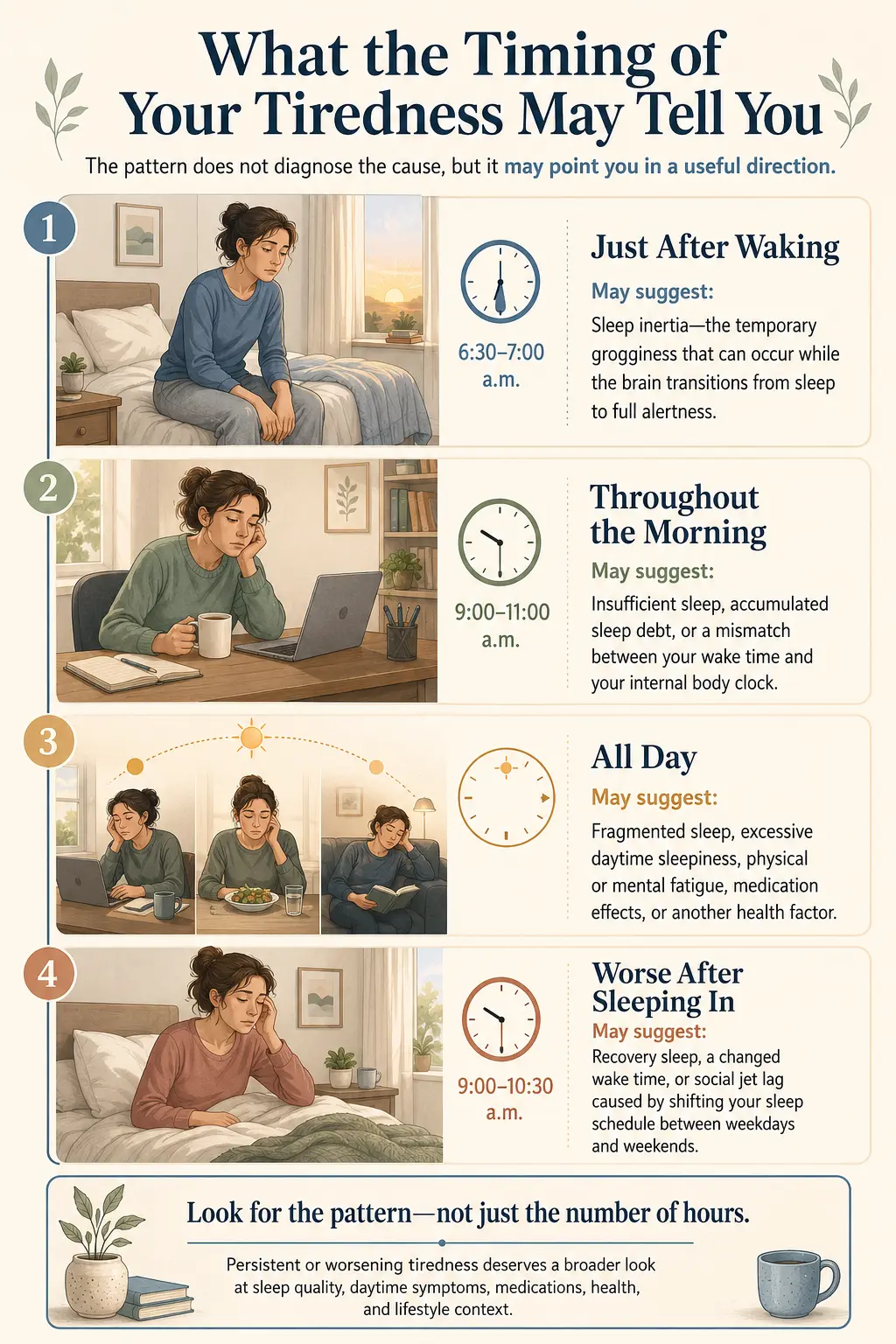
Worse After Sleeping In
Sleeping later on weekends can leave you feeling unusually heavy or disoriented. Sometimes this is simply stronger sleep inertia after a longer recovery night. Sometimes the shift in timing is the bigger factor.
Social jet lag describes the gap between the schedule imposed by workdays and the schedule followed on free days. Moving bedtime and wake time several hours later can make the return to Monday morning feel like a small change in time zone.
Sleeping in may still provide useful recovery when the working week has been too short. The important clue is what the longer sleep reveals. If you consistently sleep far beyond your alarm whenever the schedule allows it, your normal week may not be giving you enough sleep.
Quick Pattern Guide
| How the tiredness feels | Most common explanations | First thing to check |
| Groggy only for 20–30 minutes after waking, then clears | Normal sleep inertia | Nothing urgent — this is usually normal |
| Tired or foggy through the whole morning | Not enough actual sleep, sleep debt, or waking against your body clock | Compare alarm days vs natural wake days; try more time in bed |
| Sleepy all day (fighting to stay awake, nodding off) | Insufficient sleep, fragmented sleep, circadian mismatch, or medication | Sleep opportunity, interruptions, caffeine/alcohol timing |
| Fatigued all day but cannot fall asleep if you lie down | Stress, low mood, iron/thyroid issues, pain, illness, or medication | Wider health picture rather than more sleep |
| Heavier or more disoriented after sleeping in | Sleep debt recovery or social jet lag | How much extra you sleep on free days and how early you have to rise on workdays |
Why Eight Hours on the Clock Still Isn’t Always Enough
Eight hours only tells us how much time passed. It does not tell us how much of that time you were actually asleep, how often the sleep was interrupted, or whether it lined up with your body clock.
Most people count from the moment they get into bed until the alarm. That window includes the time it takes to fall asleep and any periods of waking during the night. Go to bed at 10:30 p.m. and get up at 6:30 a.m. and you have an eight-hour opportunity. Spend 30 minutes falling asleep and another 45 minutes awake overnight, and you actually slept six hours and 45 minutes.
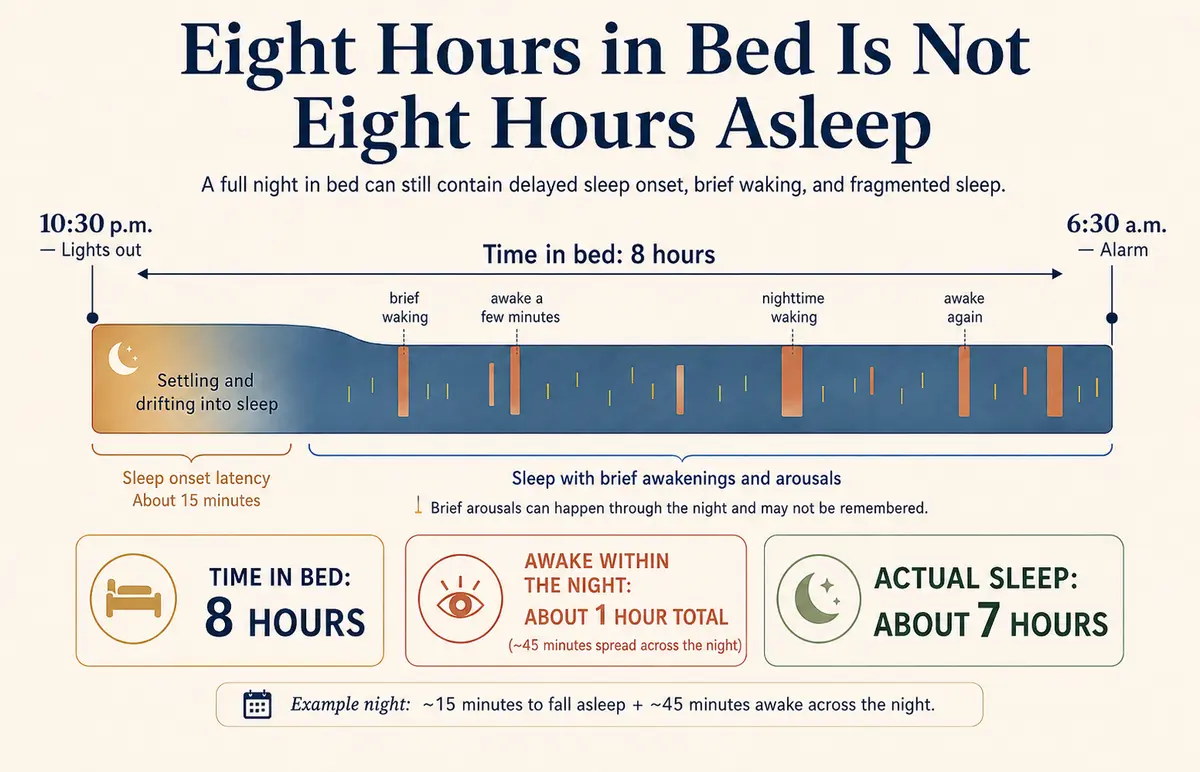
Those gaps are easy to miss the next morning. In one study of more than 2,500 adults, more than a third estimated their sleep duration at least an hour differently from what was measured objectively.
Last night’s sleep is also only part of the picture. Several short nights create sleep debt that a single solid eight-hour night does not fully repay. In a controlled study, healthy adults restricted to four hours in bed for five nights still showed lingering sleepiness and attention problems even after a recovery night of nearly nine hours of sleep.
Your needs can also shift with illness, heavy training, stress, pregnancy, or recovery from earlier sleep loss. Eight hours may be plenty in one phase of life and not quite enough in another. The useful question is not “Did I hit eight hours?” but “Was the sleep continuous, well-timed, and enough for what my body is dealing with right now?”
Why Your Sleep May Not Be Restorative
Once you have identified the pattern, the next question is what might be creating it: too little actual sleep, repeated interruptions, poor timing, or something outside sleep altogether.
Your Sleep Is Being Interrupted
You probably remember lying awake for several minutes. You are much less likely to remember an arousal that lasts only a few seconds.
Noise, heat, pain, reflux, nighttime urination, pets, children, breathing disturbances, and limb movements can all interrupt sleep. You may return to sleep before becoming fully conscious, but the interruption still breaks its continuity.
The sleep environment itself is one of the most common and fixable sources of these brief arousals. A room that is too warm, street noise or a partner’s snoring, light leaking through curtains, or even a phone that lights up during the night can repeatedly pull the brain toward wakefulness without fully waking you. Most people adapt to these disruptions and stop noticing them, yet the sleep still becomes lighter and less restorative.
Controlled sleep-fragmentation research has found that repeated interruptions can impair next-day alertness and performance even when total sleep time changes relatively little. The brain appears to care not only about how long you sleep, but also whether it can remain asleep without constantly being pulled toward wakefulness. Look for indirect clues: waking hot, visiting the bathroom repeatedly, noticing reflux or pain, or hearing from a partner that you snore, move, or breathe strangely during the night.
Brief awakenings are a normal part of sleep. A repeated pattern that leaves the night feeling light, restless, or unrefreshing is more informative.
Your Body Clock Is Out of Sync
Sleep duration and sleep timing are separate biological questions. Eight hours can still feel inadequate when they occur at a time that conflicts with your internal clock.
This commonly affects shift workers, people with very irregular schedules, and natural night owls forced into early mornings. Someone sleeping from 11 p.m. to 7 a.m. and someone sleeping from 3 a.m. to 11 a.m. obtain the same duration, but those schedules will not feel equally natural to every person.
A large difference between workdays and weekends can deepen the mismatch. Sleeping later may help repay part of a short week, but it also shifts the timing of sleep and makes the next early morning harder.
The most useful clue is often simple: do you feel and function much better when allowed to sleep and wake on your own schedule?
Caffeine, Alcohol, or Medications Are Interfering
Caffeine can affect sleep long after its obvious stimulating effect has faded. You may fall asleep at your usual time and assume it has worn off, while the night becomes shorter or more fragmented. In a controlled study, 400 milligrams of caffeine taken six hours before bedtime reduced total sleep time by more than an hour compared with placebo. That is a large dose—roughly the amount in several cups of coffee—but it shows why late-afternoon caffeine can matter even when it does not cause obvious insomnia.
Alcohol creates a different illusion. It may make you drowsy and shorten the time it takes to fall asleep, but sedation is not the same as normal sleep. Even lower doses, around two standard drinks, typically reduce REM sleep, with greater disruption as the dose increases.
Medications can affect both nighttime sleep and daytime alertness. Sedating antihistamines, sleep medications, some antidepressants, anti-anxiety drugs, pain medications, and antiseizure drugs may leave residual sleepiness the next day. Other medications can make sleep lighter or harder to initiate.
A change in medication, dose, or timing is worth noting. Prescribed medication should be reviewed with the clinician or pharmacist managing it rather than stopped abruptly.
A Sleep Disorder May Be Disrupting Your Sleep
Obstructive sleep apnea is one of the clearest examples of sleep that looks adequate but is not truly continuous.
The airway repeatedly narrows or closes, breathing becomes restricted, and the brain briefly arouses to restore it. This cycle may occur many times without the sleeper remembering any of it.
Loud habitual snoring, gasping, choking, witnessed breathing pauses, dry mouth, morning headaches, and daytime sleepiness all increase suspicion. Snoring alone is common, but snoring combined with breathing pauses or pronounced daytime symptoms is more concerning.
Sleep apnea is not limited to older men or people with obesity. Those factors raise the likelihood, but the condition occurs across body sizes, ages, and sexes.
Restless legs syndrome disrupts sleep in a different way. It causes an uncomfortable urge to move the legs, usually while resting and most strongly during the evening or night. Movement brings temporary relief, but the repeated urge can delay sleep or make it difficult to remain asleep.
The strongest clue is usually not the number of hours you report, but the combination of unrefreshing sleep, daytime symptoms, and signs that something unusual is happening during the night.
The Cause of Your Tiredness May Not Be Sleep
If your sleep is long enough, reasonably regular, and not obviously disrupted, the problem may lie elsewhere. Iron deficiency, an underactive thyroid, blood-sugar problems, depression, chronic stress, recent illness, pain, restrictive dieting, pregnancy, and medication side effects can all produce persistent fatigue even when the nights look adequate on paper.
The pattern is usually different from true sleepiness. You feel physically drained, mentally slowed, weak, or unable to concentrate, yet lying down does not make you fall asleep easily.
Look for clusters of surrounding clues:
- Heavy periods, pale skin, or unusual breathlessness → possible low iron
- Unexplained weight change, increased thirst, or frequent urination → possible blood-sugar or thyroid issue
- Low mood, loss of interest, or persistent anxiety → mental health may be contributing
- Recent infection, new medication, major dietary change, or ongoing pain → these often leave residual fatigue that extra sleep alone cannot clear
Eight hours of sleep cannot fix a problem that is not being caused by too little sleep. Persistent fatigue that comes with any of the clues above deserves a wider look at your health rather than another hour in bed.
What to Try for the Next Two Weeks
Before assuming something is wrong, give your sleep a fair test under more consistent conditions. Two weeks is long enough to reveal patterns that are difficult to see when you judge each morning in isolation.
For the next 14 days:
- Give yourself more room to sleep. Keep your wake time within about 30 minutes each day, including weekends, and allow eight and a half to nine hours in bed. This creates space for normal sleep latency and brief awakenings without automatically cutting your total sleep short.
- Get outside soon after waking. Morning light has an immediate alerting effect and helps keep the body clock anchored to the start of your day. Indoor lighting is usually far dimmer than daylight, even when the weather is cloudy.
- Move caffeine earlier and remove evening alcohol. Try having your final caffeinated drink at least eight hours before bed, or earlier if you are sensitive to it. Removing alcohol during the experiment makes it easier to see how you sleep without its initial sedation and later disruption.
- Keep a simple record. Note your bedtime, approximate sleep time, remembered awakenings, wake time, and how you feel after 30 minutes, later in the morning, and during the afternoon. Record snoring, dry mouth, headaches, nighttime urination, restless legs, and any occasions when you nearly nodded off.
You are not looking for a perfect score. You are looking for change.
Feeling better with more sleep opportunity points toward insufficient sleep or accumulated sleep debt. Improving with a steadier schedule suggests that timing may have been part of the problem. Better sleep after moving caffeine or removing alcohol gives you another useful lead.
Little or no improvement—particularly alongside snoring, breathing pauses, or unintended daytime sleep—makes further investigation more worthwhile.
When Tiredness Is Worth Investigating
If the two-week experiment leaves you just as tired, or the problem has already persisted for several weeks, it is worth looking beyond your sleep routine—especially if fatigue is affecting your work, concentration, exercise, or everyday life.
Loud habitual snoring, gasping, witnessed breathing pauses, morning headaches, or regularly struggling to remain awake during the day are also good reasons to discuss your sleep with a professional. These symptoms can occur when breathing repeatedly disrupts the night, even when you believe you slept straight through it.
Do not wait another two weeks if you are nodding off while driving. Stop somewhere safe and avoid driving while sleepy; drowsy driving is an immediate safety risk, whatever its underlying cause.
FAQs
Why am I tired after 8 hours of sleep?
Because the number of hours in bed is only one part of the story. Sleep quality, continuity, timing with your body clock, recent sleep debt, and non-sleep factors such as iron levels, thyroid function, stress, or medication can all leave you tired even after a full eight hours.
Why do I never wake up feeling rested?
You may be experiencing fragmented sleep you don’t fully remember, a mismatch between your sleep schedule and your natural body clock, residual sleep debt, or an underlying issue such as sleep apnea, low iron, or depression. The pattern of your tiredness (groggy only in the morning vs sleepy all day vs fatigued but unable to sleep) is the best clue.
Why am I tired no matter how much I sleep?
When extra sleep does not help, the cause is often outside sleep duration itself — repeated night-time interruptions, circadian misalignment, medication side effects, or a health condition that produces fatigue independently of sleep.