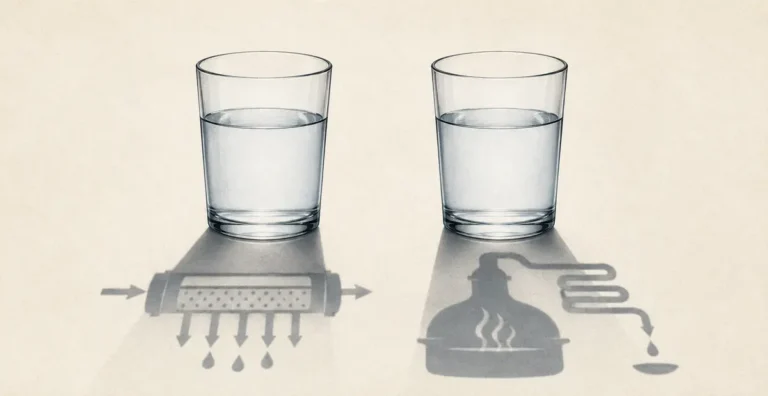
Reverse osmosis water and distilled water can look almost identical in a glass. Both contain very few dissolved minerals, both are commonly described as “purified,” and both can remove many of the things people may not want in their drinking water. So it is reasonable to wonder whether there is any meaningful difference between them at all.
There is.
Reverse osmosis uses pressure and a membrane, while distillation separates water through evaporation and condensation. That difference affects what each method removes well, where each has limitations, how practical they are for everyday drinking, and whether one can safely be substituted for the other.
This article will compare what each method removes, whether one is actually purer or healthier, and which makes more sense for everyday drinking.
Reverse osmosis vs distilled water at a glance
Reverse osmosis and distillation can both produce very clean, low-mineral water, but they work differently and come with different trade-offs. For everyday household drinking, RO is usually the more practical option.
| Reverse osmosis | Distilled water | |
| How it works | Uses pressure to push water through a membrane | Boils water, then condenses the vapor back into liquid |
| Mineral removal | Removes most dissolved minerals | Removes most dissolved minerals |
| Contaminant removal | Very effective for many dissolved contaminants; performance depends on the full system | Very effective for many non-volatile contaminants; some volatile compounds can carry over |
| Everyday drinking | Usually the more practical choice | Safe to drink, but slower and less convenient to produce regularly |
| Energy use | Generally lower | Higher because the water must be heated |
| Water waste | Produces a reject-water stream | No continuous reject-water stream |
| Maintenance | Filter and membrane replacement | Cleaning and descaling of the boiling chamber |
| Best suited for | Ongoing household drinking and cooking | Small quantities and uses where distilled water is specifically required |
The key point is that neither method is automatically “healthier” or better simply because it removes more from the water. What matters most is whether the system removes the contaminants you actually care about, and whether it fits the way you plan to use it.
What is the actual difference between RO and distilled water?
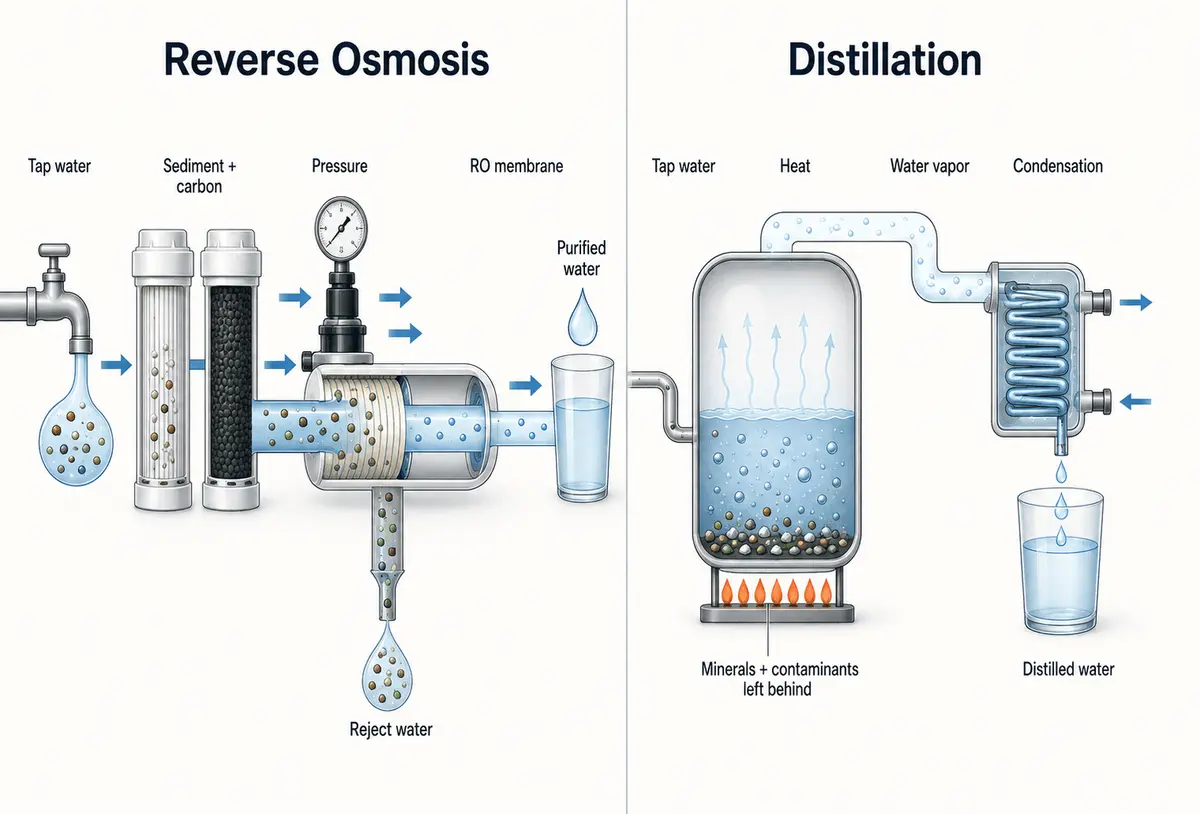
Reverse osmosis (RO) uses pressure and a membrane. Water is pushed through a membrane that lets water pass much more easily than many dissolved salts, minerals and contaminants. The purified water moves on for drinking, while a more concentrated stream carrying much of what has been removed is sent away as reject water.
In a typical household system, though, the membrane is only part of the process. The water usually passes through sediment and activated-carbon filters as well, often both before and after the RO stage.
Distillation takes a very different route. Instead of pushing water through a membrane, it heats the water until it becomes vapor, then cools that vapor back into liquid. Most minerals, salts, metals and many other contaminants do not evaporate with the water, so they are left behind in the boiling chamber.
It is tempting to think that this means distillation leaves behind everything except pure water, but it is not quite that simple. Some substances are volatile enough to travel with the vapor. The CDC notes that distillation does not reliably remove some volatile organic compounds (VOCs), volatile solvents and certain pesticides.
Because the two methods separate water differently, they do not always remove the same contaminants equally well.
See this article here for a more comprehensive look at reverse osmosis machines and if they are right for you.

Get Your Free Book!
Enter your email to get the free book and occasional updates from The New Health Order.
Which removes more contaminants?
There is no simple winner here. Both reverse osmosis and distillation can remove a wide range of contaminants, but they work differently enough that each has its own strengths and limitations.
Reverse osmosis is particularly good at reducing dissolved salts and minerals, along with contaminants such as lead, copper, chromium, fluoride and nitrate. Depending on the system, it can also be effective against arsenic, PFAS and other contaminants. Household RO systems often include activated-carbon filters too, which can help with substances that the membrane alone may not handle as well.
Its main limitation is that performance varies by contaminant and by the complete system. For some organic chemicals, for example, the carbon stages may be doing much of the work.
Distillation is particularly good at removing minerals, salts, metals and other substances that do not readily evaporate with water. This includes contaminants such as lead, arsenic and nitrate, while the heating process also makes it effective against microorganisms.
Its main weakness is volatile contaminants, some of which can travel with the water vapor rather than remaining behind. This is why some distillers add activated-carbon treatment.
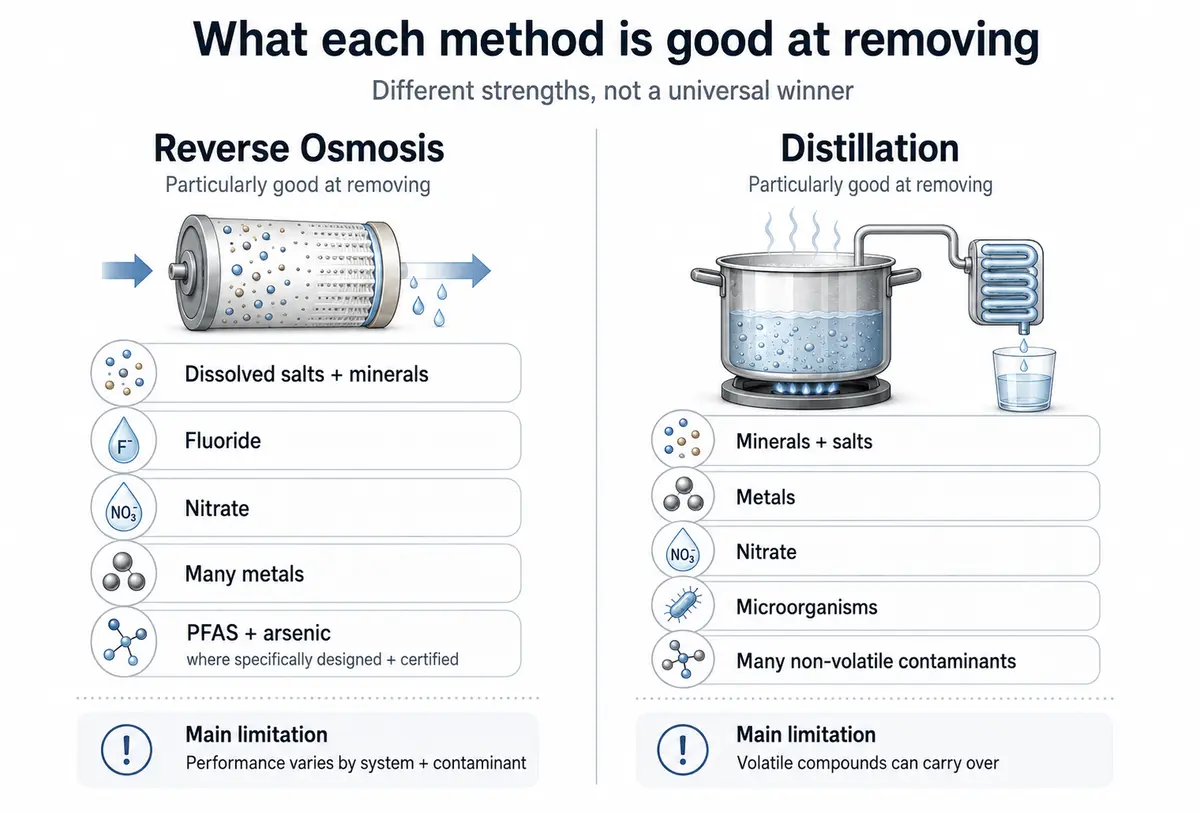
So it is difficult to say that either method simply “removes more.” A more useful comparison is:
| Particularly strong for | Main limitation | |
| Reverse osmosis | Dissolved salts and minerals, nitrate, fluoride, many metals; appropriately designed systems can also target contaminants such as PFAS and arsenic | Performance varies by contaminant and by the complete filtration system |
| Distillation | Minerals, salts, metals and many other non-volatile contaminants; also microorganisms | Some volatile chemicals can travel with the water vapor |
This is also why certification matters. Under NSF/ANSI 58, an RO system must demonstrate total dissolved solids reduction, but claims for contaminants such as arsenic, nitrate, lead, fluoride and VOCs are tested separately. In other words, seeing “reverse osmosis” on the box does not mean the system has been proven to remove everything on that list.
Is distilled water purer than reverse osmosis water?
Distilled water is often described as “purer” than reverse osmosis water because the distillation process can leave behind extremely small amounts of dissolved minerals. But whether that makes it meaningfully purer depends on what you mean by the word.
If you are simply measuring total dissolved solids (TDS), the total concentration of dissolved substances in water, distilled water will usually contain very little. RO water is also typically very low in dissolved solids, although the exact amount depends on the source water, membrane and system.
The problem is that TDS only tells you how much dissolved material is present—not what that material is. Calcium and magnesium are healthy and contribute to TDS, but so can substances you may actually want to remove. A lower number therefore does not automatically mean safer or healthier water.
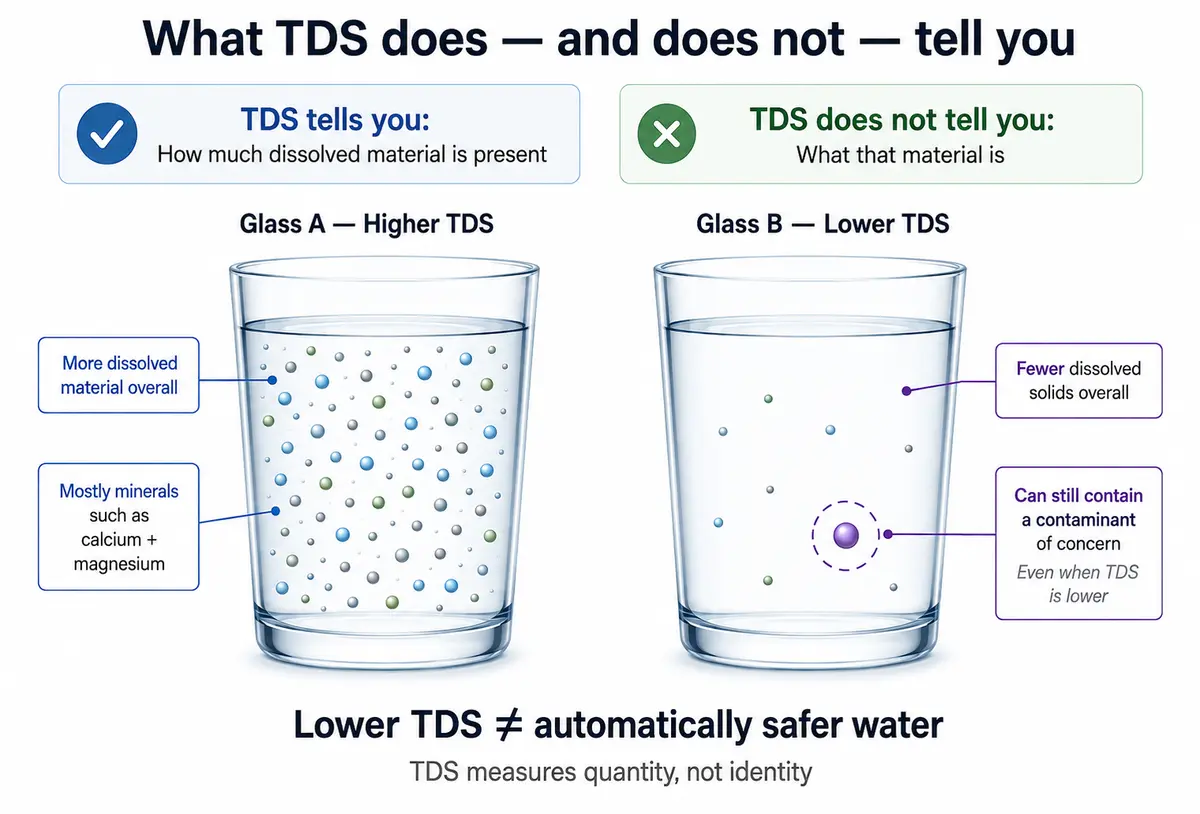
This distinction is reflected in drinking-water guidance. The World Health Organization does not set a health-based guideline for TDS, while the EPA’s 500 mg/L secondary standard is mainly concerned with issues such as taste, staining, deposits and hardness rather than toxicity.
So while distilled water may have a lower TDS, that does not automatically make it safer or healthier. What matters is what has actually been removed.
Is reverse osmosis or distilled water healthier to drink?
For most people, neither reverse osmosis nor distilled water is inherently “healthier” simply because of how it was purified.
Both methods remove much of the calcium, magnesium and other healthy minerals naturally present in water. That can sound concerning, but it helps to keep the contribution of drinking water in perspective.
Water can contribute minerals, particularly calcium and magnesium in naturally mineral-rich areas, but food is usually the much bigger source.
To put that in perspective, one U.S. study found only about 5 mg of potassium per liter of tap water on average. At that concentration, you would need around 180 liters—roughly a bathtub of water—to get the potassium found in a single baked potato. Mineral levels vary considerably between water supplies, but removing minerals from water is not automatically the nutritional problem it is sometimes made out to be.
So removing minerals from water is not the same as making the water unhealthy. It simply removes one potential source of those minerals.
This is also why claims that RO or distilled water “pulls minerals from your body” are misleading. There is no good evidence that drinking low-mineral water causes it to strip minerals from your tissues in an otherwise healthy person eating an adequate diet. The more relevant question is whether your overall diet supplies enough calcium, magnesium and other nutrients—not whether every glass of water contains them.
From a health perspective, removing a genuine contaminant matters far more than whether the final water contains slightly more or less calcium or magnesium. And because tap-water quality can vary considerably depending on where you live and the contaminants present in your local supply, the more useful question is not simply how “pure” your water is, but what is actually in your tap water in the first place.
Does RO water need to be remineralized?
Not necessarily.
Remineralization filters add minerals such as calcium and magnesium back into RO water. This can improve taste and restore some of the mineral content removed during treatment.
But that does not mean RO water must be remineralized to make it safe or healthy to drink. For most people with an adequate diet, remineralization is better thought of as an optional adjustment for taste, mineral content and water chemistry, rather than a nutritional requirement.
Which is better for everyday drinking?
For most households that genuinely need additional water treatment, reverse osmosis is usually the more practical choice for everyday drinking.
The main reason is convenience. An under-sink RO system can continuously produce treated water for drinking and cooking, while a countertop distiller usually works in batches and has to heat, evaporate and condense the water each time. That makes distillation slower and generally more energy intensive for regular household use.
RO does produce reject water and requires periodic filter and membrane replacement. Distillation avoids that continuous wastewater stream, but it uses more energy and the boiling chamber needs regular cleaning as minerals accumulate.
Distillation avoids the continuous reject-water stream, but it uses electricity, produces heat and leaves minerals and other residue behind in the boiling chamber, which needs periodic cleaning.
So for someone who wants a steady supply of highly treated drinking water, RO will usually make more sense. Distillation can still be useful when only small quantities are needed, when installing an RO system is impractical, or when a particular use specifically calls for distilled water.
Can you use RO water instead of distilled water?
Sometimes, but not always.
RO water and distilled water can both contain very low levels of dissolved minerals, which is why they may seem interchangeable. But they are produced differently and are not necessarily equivalent for every use.
For CPAP machines, humidifiers, batteries and other equipment, the manufacturer may specifically require distilled water.
In those cases, the safest rule is simple: if the manufacturer says to use distilled water, use distilled water rather than assuming RO water is an acceptable substitute.
RO water may be perfectly suitable in some applications, but “low mineral” does not automatically mean “the same as distilled.”
Final Thoughts
Reverse osmosis and distilled water are not the same, and neither is automatically healthier.
For everyday household drinking, reverse osmosis is usually the more practical choice because it provides a steady supply of highly treated water without the energy demands of distillation. Distilled water makes more sense when you only need small quantities or when a device or application specifically requires it.
Ultimately, the better choice is the one that removes the contaminants you actually need to address and suits how you plan to use the water.
FAQs
Is reverse osmosis water the same as distilled water?
No. Both can produce very low-mineral, highly purified water, but they use different processes. Reverse osmosis pushes water through a membrane under pressure, while distillation evaporates water and condenses the vapor. Because they separate contaminants differently, they also have different strengths and limitations.
Is reverse osmosis or distilled water better for drinking?
For everyday household drinking, reverse osmosis is usually the more practical choice because it can provide a steady supply of treated water without the energy demands of distillation. Neither is automatically healthier, however. What matters more is whether the treatment removes the contaminants you actually need to address.
Can you use reverse osmosis water instead of distilled water?
Sometimes, but they are not automatically interchangeable. For normal drinking, either can be suitable. But if a CPAP machine, humidifier, battery or other device specifically calls for distilled water, follow the manufacturer’s instructions rather than assuming RO water is an equivalent substitute.