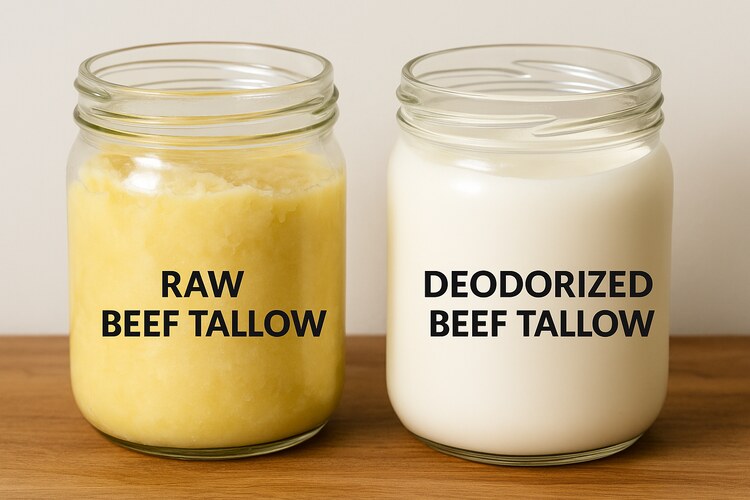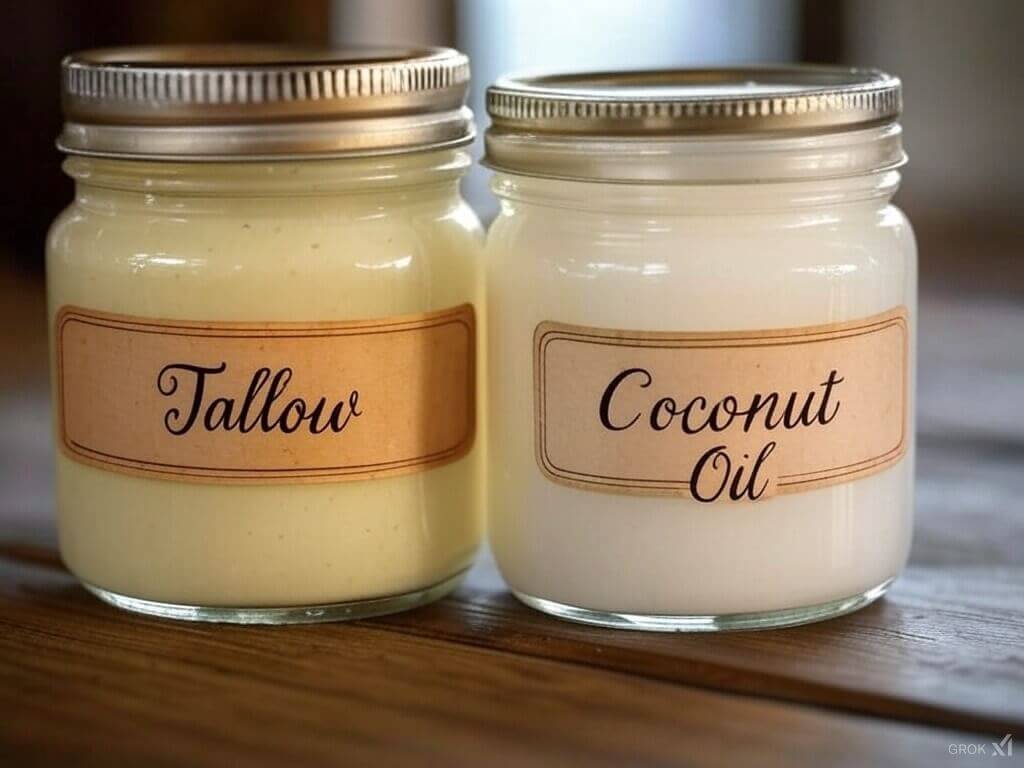

There is no perfect study that proves beef tallow will or will not clog your pores.
That is the honest starting point.
Beef tallow has a real logic as a moisturizer. It is a rich animal fat that resembles human sebum, and for some people with dry or normal skin, that can make it feel protective, softening, and simple compared with many modern skincare products.
But facial skin is usually less forgiving than dry skin on the hands, elbows, or body. A balm that feels soothing on rough, dry areas may feel heavy or congesting on skin that is oily, acne-prone, or quick to form closed comedones.
So this article is not going to tell you that beef tallow is magic, and it is not going to tell you that it is automatically bad for your skin. Instead, we’ll look at what the evidence can and can’t say, why skin type matters, how the formula changes the answer, and how to test beef tallow without turning your whole face into an experiment.
Does Beef Tallow Clog Pores? The Short Answer
Beef tallow does not automatically clog pores.
For many people with dry or normal skin, a simple, well-rendered tallow balm can work well as a rich moisturizer. It can soften dry areas, leave a protective layer, and help the skin feel less tight after washing or exposure to dry air.
The problem is that beef tallow moisturizers are not one single thing. Plain tallow is different from a tallow balm that is commonly mixed with coconut oil, cocoa butter, beeswax, essential oils, fragrance, or other heavy ingredients. It is also different depending on how much you use and whether your skin already clogs easily.
So the better answer is that beef tallow can be a good moisturizer that does not clog pores for some people (I have been using it daily for years with no issues), but it can be too heavy or pore-clogging for others that are more prone to it.
The main caution is for oily, acne-prone, or congestion-prone skin. If you already get blackheads, whiteheads, closed comedones, or breakouts from heavy creams and oils, tallow is something to test carefully rather than apply all over your face straight away.
Comedogenic ratings do not give a perfect answer either. Tallow is often treated as a moderate-risk ingredient on simple pore-clogging charts, but those charts can be misleading because real skincare products are formulas, not single ingredients. The concentration, added oils, texture, and amount used all change how a product behaves on your skin.
| Skin type or situation | Is beef tallow likely to clog pores? | Best way to approach it |
| Dry or rough skin | Lower risk for many people | Try a thin layer, especially after washing or on slightly damp skin |
| Normal skin | Depends on the formula and amount used | Start small and watch for heaviness or new bumps |
| Oily skin | Higher risk | Avoid thick daily use, especially in the T-zone (forehead, nose, and chin). |
| Acne-prone skin | Higher risk | Test carefully before using it all over the face |
| Skin prone to closed comedones | Higher risk | Be cautious with heavy balms and occlusive formulas |
| Sensitive skin | Depends heavily on the formula | Choose fragrance-free and avoid essential oils |
| Tallow mixed with coconut oil, butters, waxes, or fragrance | More likely to cause issues than plain tallow | Check the full ingredient list, not just the word “tallow” |
| Body skin, hands, elbows, or very dry patches | Often better tolerated than facial skin | Use as a targeted balm rather than assuming it belongs everywhere |
What the Science Can and Can’t Tell Us
The science on beef tallow skincare is not completely empty, but it is incomplete.
What we can measure clearly is what tallow is made of. Beef tallow is a dense animal fat, made mostly of saturated and monounsaturated fatty acids. Typical composition data puts it at roughly 50% saturated fat, 42% monounsaturated fat, and 4% polyunsaturated fat, with oleic acid, palmitic acid, and stearic acid making up much of the total.
That is what gives tallow a real logic as a skincare ingredient. It is a simple, fat-based balm that somewhat compares to natural human sebum and its natural lipid profile.
The number and scope of studies directly investigating tallow as a skin-care product are thin, however. For example, a 2024 scoping review found only 19 relevant studies on topical tallow and skin, noting that more human-focused research is still needed.
Some of the studies that do exist are useful, but they answer nearby questions rather than the exact one. Researchers have looked at tallow-based cosmetic emulsions, mutton-tallow and walnut-oil blends, skin hydration, formulation stability, wound-healing contexts, and animal models.
Those studies suggest that tallow-based products can have real moisturizing potential. But they do not tell us what happens when plain beef tallow is used as a leave-on facial balm for several weeks, especially in people with oily, acne-prone, or congestion-prone skin.
To answer that properly, we would need human studies comparing dry, normal, oily, acne-prone, and sensitive skin. We would also need to know the formula, the amount used, how often it was applied, and whether people developed clogged pores, closed comedones, irritation, or breakouts.
So we can say tallow has a sensible role as a rich moisturizer, especially for dry or normal skin. But the research cannot honestly say it is proven to be non-comedogenic for every face.

Get Your Free Book!
Enter your email to get the free book and occasional updates from The New Health Order.
Why Beef Tallow May Help Some Dry Skin
The strongest case for beef tallow is not acne or treating skin conditions, but its potential as a rich moisturizer for dry, rough, or easily stripped skin.
Dry skin often needs two things: softness and moisture retention. That is where fat-based products like tallow can shine. Emollients — ingredients that soften and smooth the skin — help improve texture, while occlusives — ingredients that form a protective layer on the skin — help slow water loss from the surface.
Beef tallow fits that basic category. It is rich, fatty, and slow to disappear from the skin. For someone with dry, rough, or easily stripped skin, that can be very useful. It can help the skin feel less tight, less flaky, and more protected, especially when used after washing or on slightly damp skin.
There is also some limited tallow-related research pointing in this direction. In the studies identified in the 2024 scoping review, two studies using mutton-tallow and walnut-oil emulsions found that these fats could be used in stable cosmetic products and were associated with improved moisturization or hydration.
For dry or normal skin, that may be enough reason to consider it. The caution is that a good moisturizer for dry skin is not automatically a good match for oily or acne-prone skin.
Why Beef Tallow May Break Out Some Acne-Prone Skin
To understand why beef tallow may be a problem for some acne-prone skin, it helps to look at how clogged pores actually form.
A pore does not usually clog just because something oily touches the skin. The blockage starts inside the follicle. Sebum mixes with dead skin cells and keratin, and instead of shedding cleanly, that material can build up into a tiny plug. This early plug is called a microcomedone. Over time, it can become a closed comedone, blackhead, whitehead, or inflamed spot.
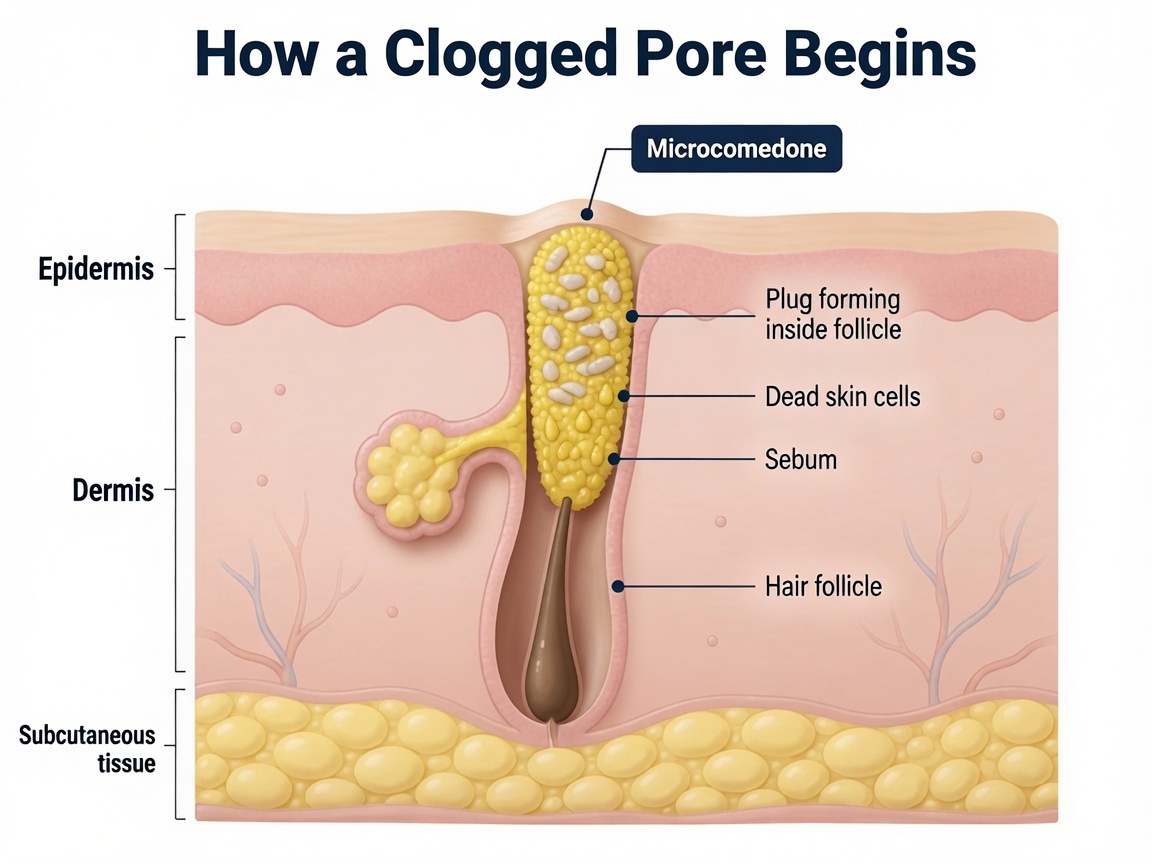
That is where rich balms can become tricky. If your skin already tends to form plugs inside the follicle, a heavy leave-on product may add more occlusion on the surface. It can trap oil, sweat, dead skin cells, sunscreen, makeup, or other skincare products against the skin. For some people, that extra layer may make congestion worse.
Tallow’s fatty acid profile adds another reason to be careful. Beef tallow is mostly made of oleic, palmitic, and stearic acids, with only a small amount of linoleic acid. Acne-prone skin is not only about how much oil the skin makes. The type of lipids present also appears to play a role.
Linoleic acid is one of the more interesting examples. In one controlled study, topical linoleic acid reduced microcomedone size by about 25% over one month in people with mild acne. Beef tallow, however, is not a linoleic-acid-rich fat. Its linoleic acid content is much lower than its oleic, palmitic, and stearic acid content.
That does not mean tallow is bad for acne-prone skin. It just means the acne-specific evidence is stronger for ingredients richer in linoleic acid than it is for tallow. If your skin clogs easily, a lighter, linoleic-acid-rich moisturizer may have a better scientific argument than a heavy tallow balm.
Palmitic acid is also worth treating with some caution. Some lab research suggests palmitic acid can encourage oil-producing skin cells to store more fat and release more inflammatory signals. While not proof that tallow causes acne, it is another reason to be cautious if your skin already clogs or inflames easily.
This lipid content is likely one of the reasons why acne-prone skin may respond differently from dry, resilient skin. Tallow is not automatically pore-clogging for normal dry skin, but it is a rich, fatty, leave-on balm. For skin that is oily, congested, or prone to closed comedones, that may be too much.
Why the Product Formula Matters
“Beef tallow skincare” can mean a lot of different things.
Some products are just plain rendered tallow with little to nothing else added. Others are whipped balms mixed with oils, butters, waxes, essential oils, and fragrances. There are also tallow soaps, body balms, face creams, lip balms, and thicker salves for hands, feet, and elbows.
For clogged pores, the formula matters as much as, if not more than, the tallow itself (see this article here for how to make the purest tallow for skin at home by yourself).
A simple, fragrance-free or deodorized tallow balm is usually the most sensible place to start on the face. It gives you the clearest test: how does your skin respond to tallow without too many extra variables?
A richer body balm is different. Something made with tallow, coconut oil, cocoa butter, beeswax, and essential oils may be great for dry legs, cracked heels, or rough elbows, but that does not mean it belongs on acne-prone facial skin.
This is also why simple comedogenic charts can only tell you so much. They usually rate single ingredients, but real skincare products are finished formulas. Human testing has shown that products containing ingredients often labelled “comedogenic” can still test as non-comedogenic when the final formula is properly made. The concentration, blend, texture, and amount used all change the result.
So instead of asking only whether tallow clogs pores, the better question is to ask what kind of tallow product is this, what else is in it, and where am I putting it?
For the face, especially if you are acne-prone, simpler is usually better. For the body, you may be able to tolerate a richer balm that would be too heavy for your cheeks, chin, or forehead.
How to Read a Tallow Balm Ingredient List
| Ingredient or formula type | Why it is added | Best use | What to watch for |
| Plain or near-plain tallow | Main moisturizing base | Face or body | Best starting point if you want to test how your skin responds to tallow itself |
| Jojoba oil | Makes the balm softer and easier to spread | Face or body | Usually one of the more face-friendly supporting oils |
| Olive oil, avocado oil, almond oil | Adds richness and glide | Dry or normal skin | Can be fine, but may feel too heavy for some acne-prone faces |
| Coconut oil | Adds softness, slip, and a familiar “natural skincare” feel | Usually better for body | Higher caution for acne-prone or clog-prone facial skin |
| Shea butter, cocoa butter, mango butter | Makes the balm thicker and creamier | Body, hands, elbows, feet, dry patches | Often more body-balm territory than daily face use |
| Beeswax | Firms the balm and makes it more protective | Lips, hands, cracked skin, body | Can make the product more occlusive and heavy on the face |
| Essential oils, fragrance, botanical extracts | Added for scent, marketing, or “calming” claims | Body, if tolerated | More irritation risk, especially for sensitive facial skin |
| Vitamin E / tocopherol | Helps slow oxidation and support shelf life | Face or body | Usually not the main pore-clogging concern |
How to Test Beef Tallow on Your Face
If you want to try beef tallow on your face, do not start by covering your whole face in it every night. Instead, start small.
A patch test can help you spot obvious irritation, redness, itching, burning, or allergy-type reactions. But clogged pores are different. They can take longer to show up, so one quick patch test does not prove a product is acne-safe.
A better approach is to test it in stages.
First, choose the simplest formula you can find. Ideally, that means a plain or near-plain tallow balm without fragrance, essential oils, coconut oil, or a long list of added butters and waxes.
Then apply a tiny amount behind the ear, under the jawline, or on a small area near the side of your face. Use it for a few nights and watch how your skin responds.
If that goes well, try a very thin layer on one small facial area. Not your whole face and not a thick coat. Think thin layer, not frosting.
During this test, do not start three other new skincare products at the same time. Otherwise, if your skin reacts, you will have no idea what caused it.
Watch for new bumps, closed comedones, blackheads, whiteheads, increased congestion, itching, redness, or a greasy feeling that does not settle. If your skin clearly gets worse, stop using it.
This is especially important if you have oily or acne-prone skin. Tallow may be a good fit for some people, but in the absence of adequate studies, your own skin is the real and final test.
Final Thoughts: Should You Use Beef Tallow on Your Face?
Beef tallow may be worth trying if your skin is dry, normal, or easily stripped, and if you usually tolerate richer balms well.
It makes the most sense when the formula is simple, fragrance-free, and used in a very small amount. In that context, tallow is not just a random skincare trend as many would make it seem, but a rich fat-based moisturizer that may help soften dry skin and slow moisture loss from the surface.
But if your skin is oily, acne-prone, or prone to closed comedones, it deserves more caution. The fact that tallow is natural does not automatically mean it will suit your face. A heavy balm can still be too much for skin that already clogs easily.
The most honest answer is that beef tallow is not proven to be universally pore-clogging, but it is also not proven to be reliably non-comedogenic for every face.
So the best approach is practical: choose a good-quality, simple formula, test a tiny amount first, and pay attention to your own skin. If it makes your skin feel calmer, softer, and less dry, it may be a good fit. If you notice new bumps, congestion, irritation, or breakouts, your face is telling you it is probably not the right product for you.
Beef tallow does not need to be treated as magic, and it does not need to be dismissed as dangerous. Like most skincare, it depends on the person, the product, and the way it is used.
FAQs
Is beef tallow comedogenic?
Beef tallow may be comedogenic for some people, but there is no reliable rating that predicts how every person’s skin will react. Its rich, occlusive texture may suit dry or normal skin but feel too heavy for oily or congestion-prone skin. The complete formula and amount applied also matter.
Can beef tallow cause acne?
Beef tallow can contribute to breakouts if it clogs your pores or traps oil, dead skin cells, sweat, or other products against the skin. This is more likely in people with oily or acne-prone skin. However, not everyone who uses beef tallow will develop acne.
Is beef tallow good for acne-prone skin?
Beef tallow is generally not the most predictable choice for acne-prone skin because it is a rich, heavy moisturizer and has not been proven to treat acne. Anyone prone to blackheads, whiteheads, or closed comedones should test a small amount before applying it across the entire face.