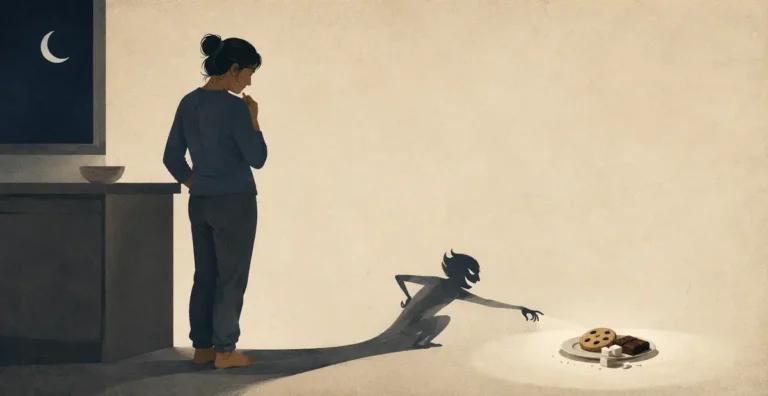
The evening has a way of changing our relationship with food. A piece of chocolate that barely crossed your mind during the afternoon can feel remarkably persuasive at 9 p.m.—even when you ate dinner only an hour ago.
Nighttime sugar cravings do not all come from the same place. Sometimes you are genuinely hungry because you ate too little earlier or dinner did not satisfy you for long. At other times, you are physically full but still want something sweet because dessert has become part of your evening routine, or because your brain is looking for a different taste and an easy reward. Poor sleep, stress, and hormonal changes can make either kind of urge stronger.
This article will help you tell the difference by looking at when the craving appears, whether ordinary food also sounds appealing, and what tends to happen just before it. Once you understand what is driving the urge, you can respond to the cause rather than relying on willpower alone.
Why You Crave Sugar at Night
Nighttime cravings rarely come from one isolated cause. The evening creates a biological background in which food often becomes more appealing, while your eating pattern, sleep, stress, and habits determine how strongly you feel it.
Appetite Often Rises in the Evening
Hunger is not a flat signal that rises only according to how long it has been since your last meal. It is also influenced by your circadian rhythm—the internal timing system that coordinates sleep, hormones, digestion, and metabolism across the day.
For example, in a small 13-day laboratory study, researchers separated the effects of the body clock from ordinary meal and sleep schedules. Participants’ reported hunger was lowest at around 8 a.m. and highest at around 8 p.m., with the evening peak measuring 17% higher than the morning low relative to their average hunger level across the day. The desire for sweet, starchy, and salty foods also varied by approximately 14-25% across the day.
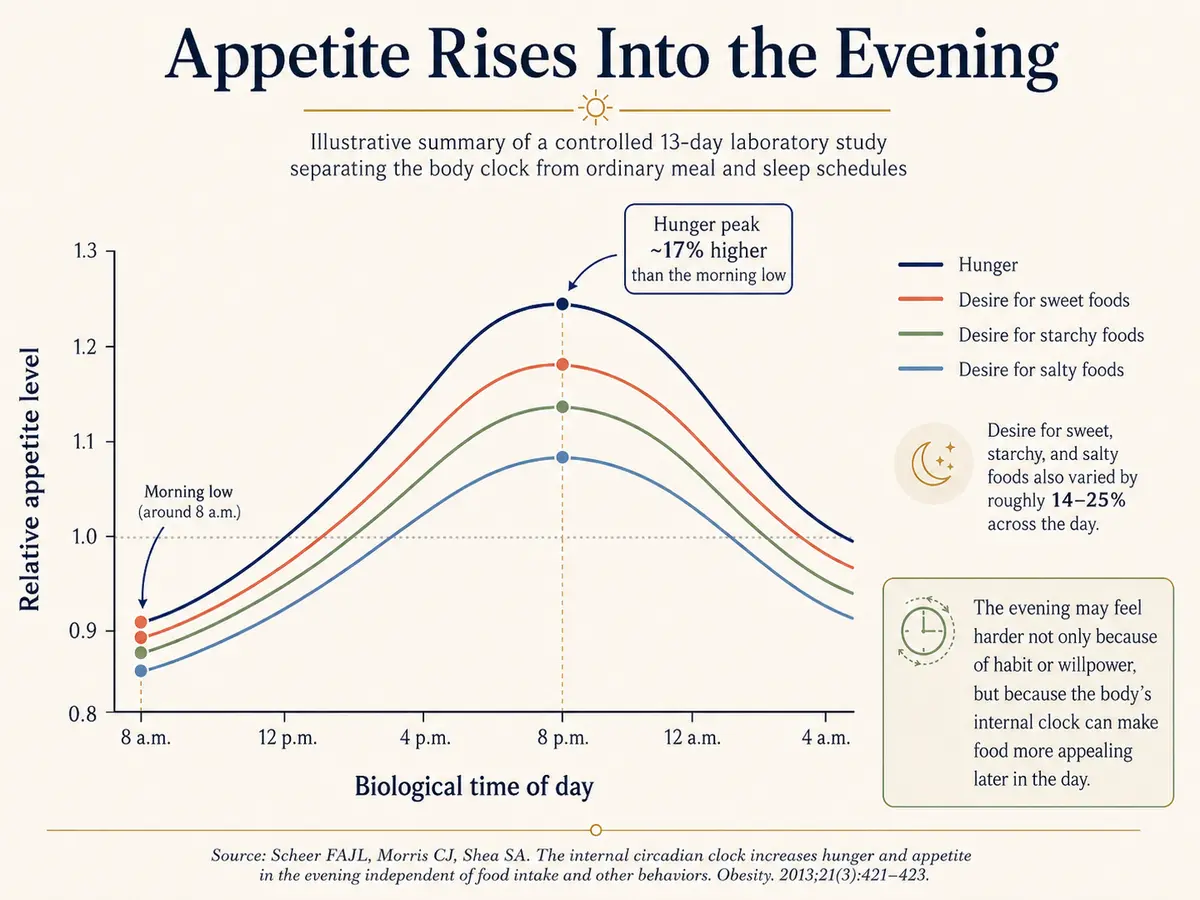
These appetite signals appear to be coordinated partly by the brain’s central clock. One possible reason for this is that a stronger evening appetite encourages us to eat before the long overnight period without food. Lower morning appetite may also explain why some people can comfortably delay breakfast despite having fasted throughout the night.
But circadian timing does not specifically instruct you to eat cookies or ice cream— it just raises the background drive to eat. At 10 a.m., a bowl of ice cream may be easy to ignore. At 9 p.m., when appetite is naturally higher and the day’s demands have worn you down, the same food can become much more compelling.
You May Not Be Eating Enough During the Day
Sometimes a nighttime sugar craving is simply hunger arriving late.
A skipped breakfast, a hurried lunch, or an afternoon held together with coffee can feel manageable while you are occupied. But once the day slows down, the hunger you postponed earlier becomes much harder to ignore.
At that point, your body may not be asking for sugar specifically. It is asking for food. Sweet foods often become the obvious answer because they are convenient, energy-dense, and rewarding. Chocolate or cereal may therefore feel like the object of the craving even when the underlying problem is broader hunger.
One small crossover study illustrates how strongly earlier restraint can affect later appetite. Ten men created a 25% energy deficit of around 700 calories per day for three days, either by eating less or exercising more.
When they were later given access to a buffet, they ate an average of 1,186 calories after food restriction, compared with 713 calories after exercise and 654 calories under normal conditions. They also felt hungrier and rated the food as more appealing. The appetite suppressed earlier had not disappeared; it returned more forcefully when food became available.
You do not have to eat breakfast, and there is no single meal schedule that suits everyone. The better question is whether your schedule works for you. Someone who comfortably delays eating and feels steady through the evening is in a different position from someone who spends the day managing hunger and then loses control around the snack cupboard at night.
One way to distinguish a sugar craving from genuine hunger is to imagine several ordinary foods. Would you eat leftovers, eggs, yogurt, fruit, or a sandwich? If the answer is yes, the “sugar craving” may be general hunger wearing a more attractive disguise.
Dinner May Be Too Low in Protein, Fiber, or Total Food
Eating dinner does not necessarily mean you ate enough.
A meal can create temporary fullness because it occupies space in the stomach without providing enough energy or staying power to carry you through the evening. A small salad topped with a few pieces of chicken may look balanced on paper, but it can still leave you looking for food an hour later.
Protein is especially helpful for extending satisfaction after a meal. Fiber-rich foods can add volume and slow digestion, while fats and minimally processed carbohydrates can also contribute to a meal that feels complete. But none of these components can compensate indefinitely for a dinner that is simply too small.
It’s an important distinction because the answer is not always to add more protein powder or force down vegetables. Sometimes the missing ingredient is just food.
Consider when the craving arrives. If you ate a light dinner at 6 p.m. and by 8 p.m. almost any meal or snack sounds appealing, dinner may not have matched your needs. A larger portion, a clear source of protein, and foods such as beans, potatoes, whole grains, vegetables, or fruit may help the meal last longer.
Poor Sleep, Stress, and Hormonal Changes Can Intensify Cravings
Some evenings, the craving is stronger because your brain and body are in a different state.
Poor sleep can make sweet, energy-dense foods feel more rewarding while weakening the pause between wanting something and acting on it. For example, in one crossover study, 24 adults slept for either five or eight hours per night. After the shorter-sleep period, they preferred a noticeably sweeter sugar solution and ate more calories and carbohydrates when offered breakfast.
Stress is less predictable. Some people lose their appetite; others become more interested in familiar comfort foods. The craving may appear after the stressful event has passed, when work is finished and food offers a quick transition from tension to relief.
For many women, appetite can also change across the menstrual cycle. A 2024 analysis of 15 datasets found that average energy intake was approximately 168 calories higher during the luteal phase—the period after ovulation and before menstruation—than during the earlier follicular phase. Individual responses varied considerably, but the pattern may explain why cravings reliably strengthen during the same few days each month.
Sleep, stress, and hormonal changes are best understood as amplifiers, not sources of craving on their own. They do not create identical cravings in everyone, but they can turn a manageable appetite, an established dessert habit, or a modest desire for reward into something much harder to ignore.
Why You Crave Sugar Even When You Are Full
Physical fullness is only one part of appetite.
Your stomach and digestive system send signals that you have eaten enough, but the brain also responds to taste, novelty, reward, memory, and expectation. Those systems overlap, but they do not always switch off at the same moment.
This is partly explained by sensory-specific satiety. As you eat a food, your interest in its particular taste and texture gradually declines. By the end of dinner, you may be thoroughly finished with roasted chicken and vegetables while remaining interested in something cold, sweet, creamy, or crisp.
Dessert introduces a different taste and texture. The expression “there is always room for dessert” is not literally true, but it captures something real: being satisfied with one category of food does not eliminate interest in another.
The brain also learns sequences. When dinner is repeatedly followed by chocolate, ice cream, or a trip to the snack cupboard, the end of the meal becomes a cue. Repeated often enough, those moments become linked with the food and begin to trigger anticipation on their own.
The cue may not even be dinner itself. It could be sitting in a particular chair, making tea, turning on the television, or finally being alone after putting the children to bed. Repeated often enough, those moments become linked with the food and begin to produce anticipation before you have consciously decided to eat.
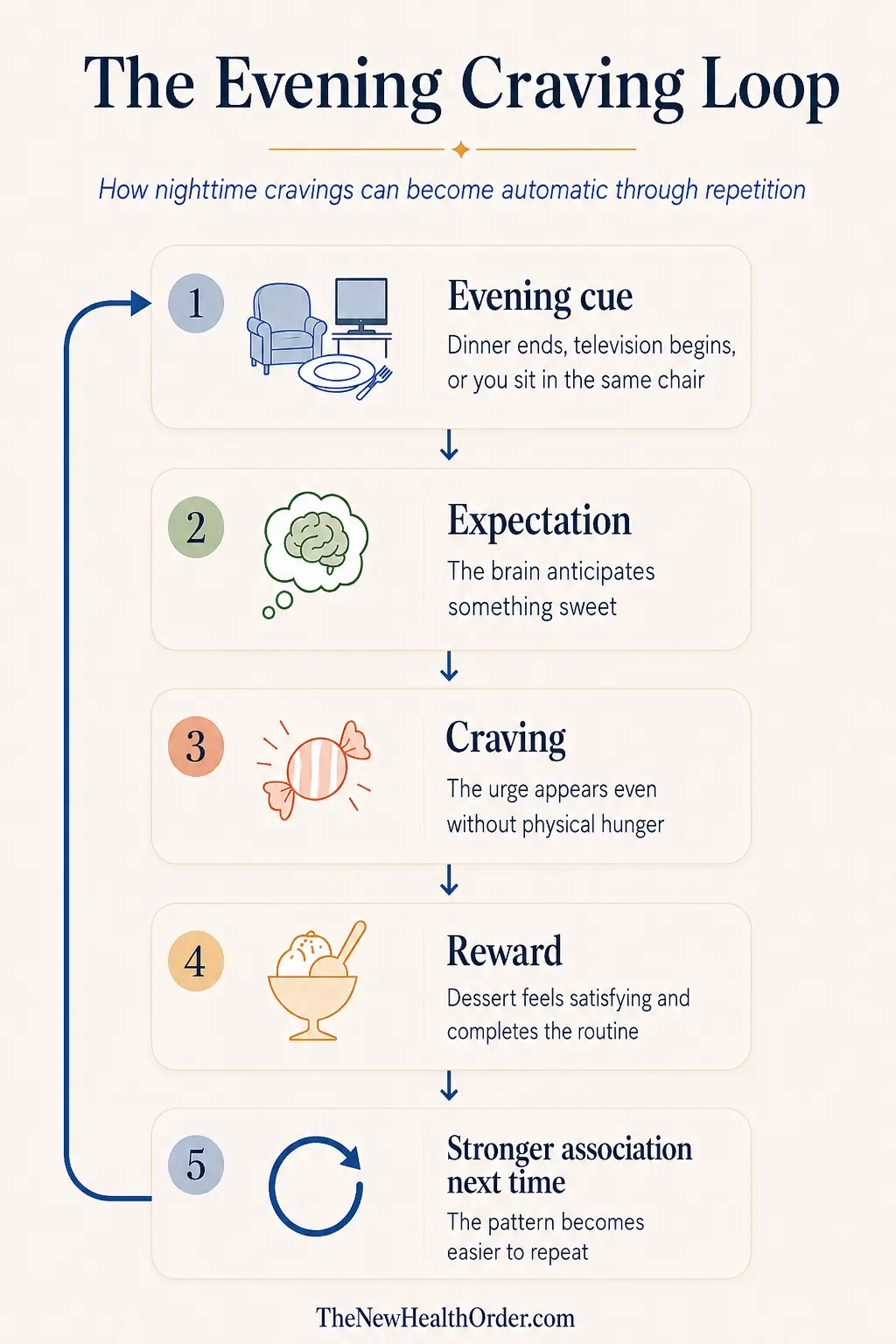
A meta-analysis involving 3,292 participants found that food cues—and the cravings they triggered—accounted for about 11% of the variation in later eating. In other words, cues alone explained roughly one-ninth of the differences in how much people ate, despite hunger, mood, food availability, and other factors also shaping intake.
This helps explain why the urge can arrive at almost the same moment each evening, even when your hunger and dinner have changed. The consistency points to a learned cue: a particular time, place, or activity has become associated with eating something sweet.
The distinction is useful because cue-driven cravings and physical hunger do not respond in the same way. Hunger usually broadens your interest in food, while a learned craving tends to remain tied to one familiar food or routine.
What Your Nighttime Craving May Be Telling You
| What you notice | What may be driving it | What to try first |
| Almost any food sounds good | Genuine hunger or too little food earlier | Eat more earlier or choose a substantial snack |
| Hunger returns one or two hours after dinner | Dinner was too small or lacked staying power | Increase the portion and include protein, fiber, and a substantial carbohydrate source |
| You feel full but only want something sweet | Reward, sensory variety, or dessert expectation | Plan a portion of dessert rather than eating more dinner |
| The craving appears at the same time or during the same activity | A learned cue or routine | Change what happens immediately after the cue |
| Cravings are stronger after poor sleep or stressful days | Sleep and stress are amplifying the urge | Address the underlying fatigue or stress and plan ahead for those evenings |
| Cravings rise before your period | Normal appetite changes across the menstrual cycle | Expect the pattern and make meals or snacks more substantial if needed |
| The urge comes with shaking, sweating, dizziness, or confusion | Possible low blood glucose | Seek appropriate medical guidance, especially if using glucose-lowering medication |
Get Your Free Book!
Enter your email to get the free book and occasional updates from The New Health Order.
How to Reduce Sugar Cravings at Night
The most effective response depends on what is driving the craving. If you are genuinely hungry, you may need to eat more earlier or make dinner more satisfying. If the urge appears as part of a familiar evening routine, changing the cue may matter more than changing the meal. And if you are comfortably full but simply want dessert, planning for it may work better than turning it into a nightly test of willpower.
Eat Enough Earlier in the Day
At first, this advice can seem backward. If you eat more in the morning or afternoon, you have fewer calories left for the evening—so wouldn’t that make you hungrier at night?
Not necessarily. In a randomized crossover trial, 30 adults ate the same total calories with either 45% at breakfast and 20% at dinner, or the reverse. Weight loss was the same under both schedules, but participants reported less hunger when more of their food was eaten earlier in the day.
One possible reason is that earlier meals reduce the energy gap that builds before dinner. Instead of arriving home ravenous and trying to satisfy most of the day’s hunger at once, you reach the evening with a more manageable appetite. Food eaten earlier may also affect satiety for longer than we assume; it does not simply stop mattering a few hours after the meal.
This is most likely to help people who eat lightly while busy, become intensely hungry by dinner, and then continue grazing afterward. It does not mean forcing yourself to eat a large breakfast or making dinner too small. Keep dinner satisfying, but try moving some of the food you usually eat after dinner into lunch or an afternoon snack.The goal is to reach dinner hungry enough to enjoy it, but not so hungry that the rest of the night becomes an attempt to catch up.
Address Genuine Hunger First
If several ordinary foods sound appealing, respond to the hunger rather than treating it as a sugar problem. If you arrive at dinner ravenous, move some food into lunch or an afternoon snack. If hunger returns soon after dinner, increase the meal using the principles discussed earlier: enough total food, a meaningful protein source, and a fiber-rich carbohydrate source.
If you are comfortably full and only want one particular dessert, making dinner larger is unlikely to solve the craving.
Change the Evening Cue or Routine
When the craving arrives at roughly the same time each night, it may be tied as much to what you are doing as to how hungry you are. Dinner ends, you sit down to watch television, and your mind begins looking for the food that normally accompanies that moment.
Trying to resist the dessert while leaving the rest of the sequence unchanged can be difficult. The chair, the program, and the time of night are already prompting the expectation. It is often easier to alter one part of the routine: leave the kitchen after dinner, take a short walk before sitting down, or have your evening drink somewhere you do not usually snack.
The change does not need to be dramatic. Even keeping sweets out of immediate sight can create enough distance for you to notice whether you genuinely want them or are simply following the usual sequence.
The craving may still appear at first. That is expected. But when the same evening cue repeatedly leads somewhere different, the association can gradually weaken, and the urge becomes less automatic.
Plan Dessert or a Balanced Snack
Not every nighttime craving needs to become a contest of willpower. Sometimes it is easier—and more sustainable—to decide what you are going to eat rather than spend the evening trying not to eat anything.
If you are genuinely hungry, choose something substantial enough to settle it. Yogurt and fruit, oatmeal with milk, or eggs and toast will usually do more than a small sweet that leaves you looking for food again twenty minutes later.
If dinner satisfied you and you simply want something sweet, a planned dessert may be all that is needed. That could be fruit and yogurt, a few squares of chocolate, or a portion of the dessert you actually wanted in the first place.
The value of planning is that the craving has a clear endpoint. You eat something that matches the urge, enjoy it, and continue with the evening instead of resisting for an hour and then grazing through several different foods.
When to Seek Medical Advice
A nighttime sugar craving on its own is usually nothing to be alarmed about. It becomes more important when it appears alongside other symptoms or when your nighttime eating begins to feel difficult to control.
Speak with a healthcare professional if you are also experiencing persistent thirst, frequent urination, unexplained weight loss, blurred vision, unusual fatigue, slow-healing sores, or constant hunger despite eating. These can be signs of diabetes and are worth checking properly rather than trying to interpret at home.
A craving that comes with shaking, sweating, dizziness, a racing heartbeat, weakness, confusion, or changes in vision or speech may point to low blood glucose rather than an ordinary desire for something sweet. This is particularly important for anyone using insulin or other glucose-lowering medication.
It is also worth seeking support if nighttime eating regularly feels out of control, causes significant guilt or distress, or involves waking to eat—especially when you have little or no memory of it the next morning.
For most people, the craving is part of a normal pattern of hunger, reward, habit, or stress. The reason to seek help is not the craving alone, but the wider picture around it.
Final Thoughts
When a nighttime sugar craving appears, first ask whether ordinary food also sounds good. If it does, address the hunger: eat enough earlier in the day, make dinner more substantial, or choose a balanced snack.
If you are comfortably full and only want something sweet, look at the routine around the craving. Change the cue, plan a portion of dessert, or simply allow yourself something sweet without turning it into a struggle.
The goal is not to eliminate every craving. It is to understand what is driving it and respond in a way that actually satisfies the need.
FAQs
Why do I crave sugar at night even after a filling dinner?
Fullness does not completely switch off food reward. Sweet foods offer a different taste and texture from dinner, and a regular after-dinner routine can train your brain to expect dessert even when you are no longer hungry.
How can I tell whether a nighttime sugar craving is hunger or habit?
Ask whether ordinary food also sounds appealing. If leftovers, eggs, yogurt, or fruit sound good, you are probably hungry; if you feel full and only one specific sweet food will do, habit, reward, or an evening cue is more likely involved.
Does craving sugar at night mean my blood sugar is low or that I have diabetes?
A sugar craving alone is not a reliable sign of either condition. Seek medical advice if it appears with shaking, sweating, dizziness, confusion, persistent thirst, frequent urination, unexplained weight loss, blurred vision, or unusual fatigue.