The thyroid is one of the few systems in the body that really can change your metabolic pace. But it is also one of the most overblamed. It can affect energy, body temperature, and weight in real and meaningful ways, yet it is often treated as a catch-all explanation for fatigue, stubborn pounds, and that feeling of just being “off.”
The truth sits somewhere in the middle. The thyroid matters, sometimes a great deal, but it is not the answer to everything, as some make it out to be. In this article, we will look at what the thyroid actually does, how it influences metabolism and energy, how much it really affects body weight, what signs can point to a genuine thyroid problem, and how thyroid issues are properly tested. By the end, you should have a clearer sense of what the thyroid can realistically explain, where people often overstate its role, and how to think about it in a more grounded way.
What the Thyroid Does
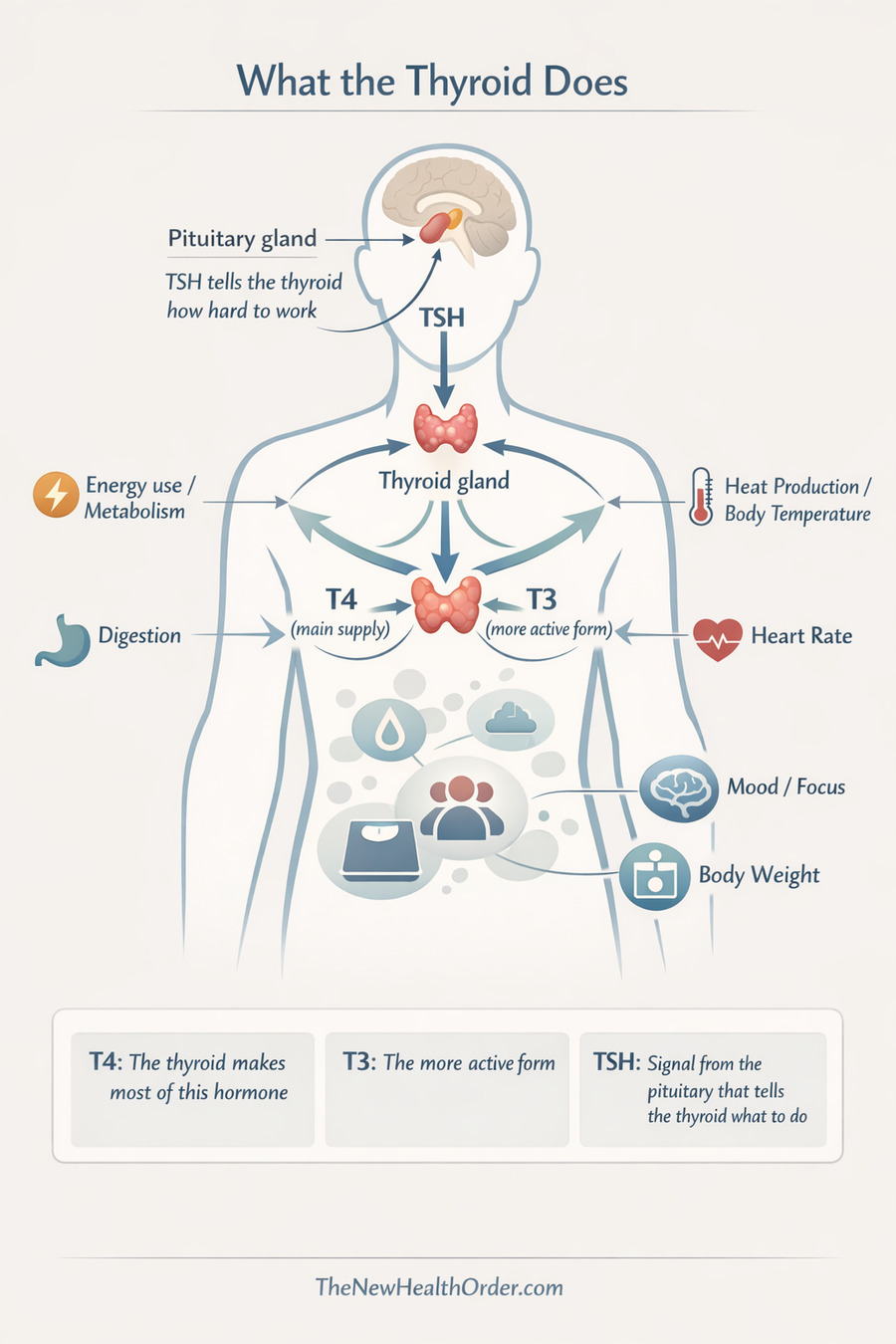
The thyroid is a small gland in the front of the neck, but it plays a much larger role than most people realize. Its main job is to help regulate the speed of many processes throughout the body. It influences how quickly you use energy, how much heat you produce, how active your digestion is, how fast your heart tends to beat, and how efficiently many tissues carry out their day-to-day work.
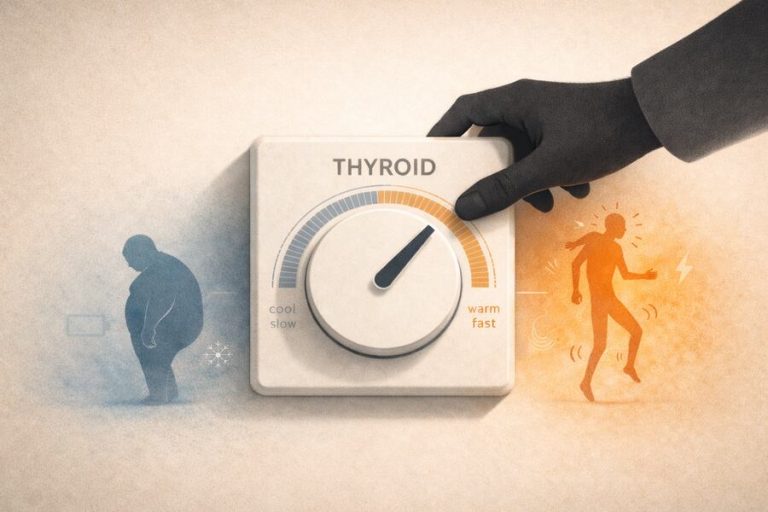
That is why the thyroid is so often linked to the way a person feels overall. When thyroid function is too low, things can begin to feel slower, heavier, and more sluggish. When thyroid function is too high, the body can start to feel overactive and hard to settle. It is not the only system that affects energy, metabolism, or body weight, but it is one of the few that really can change the body’s overall pace in a meaningful way.
T4, T3, and TSH
The thyroid does this through hormones, mainly T4 and T3. These names are short for thyroxine and triiodothyronine, and the numbers simply refer to how many iodine atoms each hormone contains. T4 has four, and T3 has three. You do not need to remember the chemistry, but it helps explain why the names sound so technical.
T4 is the hormone the thyroid makes in the largest amount. You can think of it as the main supply. T3 is the more active form, and much of it is made by converting T4 into T3 in other parts of the body. That active T3 is what helps influence how strongly thyroid hormone affects cells and tissues.
TSH works a little differently. It stands for thyroid-stimulating hormone, and it is not made by the thyroid at all, but by the pituitary gland in the brain. Its role is to tell the thyroid how hard it should be working. When thyroid hormone levels are low, TSH usually rises as the body tries to push the thyroid to make more. When thyroid hormone levels are high, TSH usually falls because the body is trying to reduce the signal. That is why TSH is often the first number looked at on a thyroid blood test.
Why the Thyroid Affects so many Parts of the Body
Thyroid problems can seem to cause such a wide mix of symptoms because the thyroid hormone acts throughout the body rather than in just one place. It helps shape the general tempo of how the body runs. Because of that, thyroid issues can show up through energy, temperature tolerance, digestion, skin, heart rate, mood, and body weight, rather than through one single obvious sign.
This is also why thyroid symptoms can sometimes feel vague at first. A person may simply feel more tired, colder, slower, or more mentally foggy than usual, without immediately knowing why. On the other side, someone with an overactive thyroid may feel hotter, shakier, more restless, or more on edge. The common thread is that thyroid hormone helps regulate the pace of the body, so when it shifts too far in either direction, the effects can be felt in many places at once.
How the Thyroid Affects Metabolism and Energy
Thyroid hormones help regulate how quickly the body uses energy. They influence the rate at which cells carry out work, how much heat the body produces, and how active many everyday processes remain in the background. This is why thyroid problems can affect far more than just one symptom. They can change the way the whole body feels.
When people talk about having a “fast” or “slow” metabolism, they often mean it loosely. But thyroid hormone is one of the real biological systems that can shift the body’s pace in a meaningful way.
It does not control everything, and it does not explain every change in energy or weight, but it does help set the general speed at which the body runs. In one prospective study, resting energy expenditure adjusted for lean body mass fell by about 21% after patients moved from overt hyperthyroidism back to normal thyroid function, which gives a useful sense of how strongly thyroid status can influence the body’s baseline energy use.
Why Low Thyroid can make the Body feel Slower
When thyroid hormone levels are too low, many processes in the body begin to ease down. Energy is used more slowly, heat production falls, and the general pace of the body can start to feel reduced. For some people, this shows up as tiredness and low motivation. For others, it is more a feeling of heaviness, sluggishness, mental fog, or finding it harder to stay warm than usual.
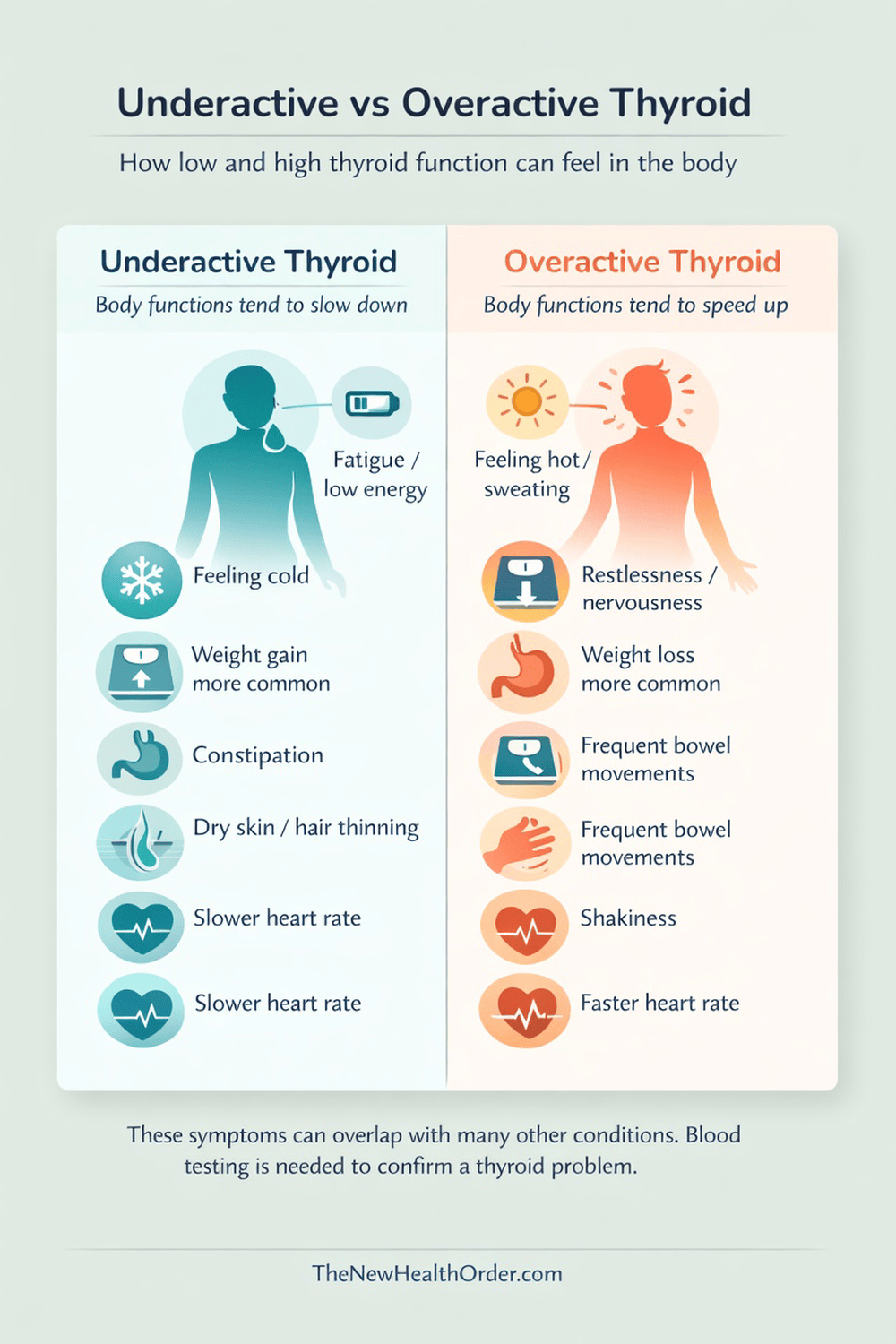
This helps explain why an underactive thyroid is often associated with symptoms like fatigue, cold intolerance, constipation, dry skin, and a slower heart rate. It is not that every system simply “switches off,” but rather that the body starts running at a lower speed than it should. Even normal daily tasks can feel as though they require more effort.
That said, this does not mean every tired or low-energy person has a thyroid problem. Fatigue is one of the most common symptoms in medicine, and many different things can cause it. The point is simply that when thyroid function is genuinely low, a slower-feeling body is not imagined or vague. It has a real physiological basis.
Why High Thyroid can make the Body feel Faster
When thyroid hormone levels are too high, the opposite pattern can happen. The body starts running at a quicker pace, and that can feel uncomfortable in a very different way. Instead of feeling slowed down, a person may feel restless, overheated, jittery, or as though their system is always slightly overactive.
This is why an overactive thyroid can be linked with symptoms like heat intolerance, a faster heartbeat, shakiness, nervous energy, and sometimes unintentional weight loss. The body is not just using energy differently on paper. It often feels more revved up in a way that is hard to ignore.

Get Your Free Book!
Enter your email to get the free book and occasional updates from The New Health Order.
How Much the Thyroid Affects Weight
The thyroid does affect body weight, but usually in a narrower and less dramatic way than people expect. Because thyroid hormone helps regulate how much energy the body uses at rest, an underactive thyroid can make weight gain more likely, while an overactive thyroid can push weight in the other direction. But body weight is never controlled by thyroid hormone alone. Appetite, fluid balance, activity, other hormones, and everyday eating patterns all matter too, which is why the relationship is real without being all-powerful.
Why Hypothyroidism can Cause Weight Gain
When thyroid hormone levels are too low, the body tends to use energy more slowly. That can reduce calorie burn and make weight gain easier over time. But hypothyroidism can also affect body weight in another way that is often overlooked: it can lead to more salt and water retention. In other words, the increase on the scale is not always the same thing as a large increase in body fat.
This is one reason people with an underactive thyroid may notice that they feel not only heavier, but also puffier, slower, or more swollen than usual. The thyroid is affecting the body’s general pace, but it is also changing the body’s handling of fluid and overall physiology. That makes the weight effect real, even if it does not always reflect the kind of fat gain people assume.
The Weight Effect is usually Smaller than People Think
This is where a lot of thyroid discussion goes off track. Popular media often gives the impression that an underactive thyroid is a major hidden cause of large weight gain, or that fixing the thyroid will lead to major weight loss. In reality, the effect is usually much smaller. The American Thyroid Association notes that for most patients, roughly 5 to 10 pounds of weight gain may be related to hypothyroidism, depending on how severe it is, and that much of this is due to salt and water retention rather than large fat gain.
For a more in-depth look at what the science says about fat loss and weight gain, see this article here.
That also helps explain why thyroid treatment is not a weight-loss shortcut. When hypothyroidism is treated and thyroid levels return to normal, some of the thyroid-related weight may come off, especially if retained fluid is part of the picture. But the overall change is often modest. In one retrospective cohort study of 101 adults treated for primary hypothyroidism, overall weight change after levothyroxine was minimal. Although 52% of patients lost weight, nearly half did not, leaving the typical overall change close to zero.
In other words, treating real hypothyroidism matters, but it does not turn the thyroid into a hidden answer to obesity. Once thyroid levels are back in range, the ability to gain or lose weight is generally the same as it is for people without a thyroid problem.
The most useful way to think about it is this: the thyroid can meaningfully influence body weight, but usually not on the scale people imagine. It can nudge the body toward weight gain or loss by changing metabolic pace and fluid balance, yet it rarely explains large weight changes all by itself. That is why the thyroid deserves to be taken seriously, but also why it should not be blamed for every stubborn pound.
Not Every Mild Thyroid Abnormality Means the Same Thing
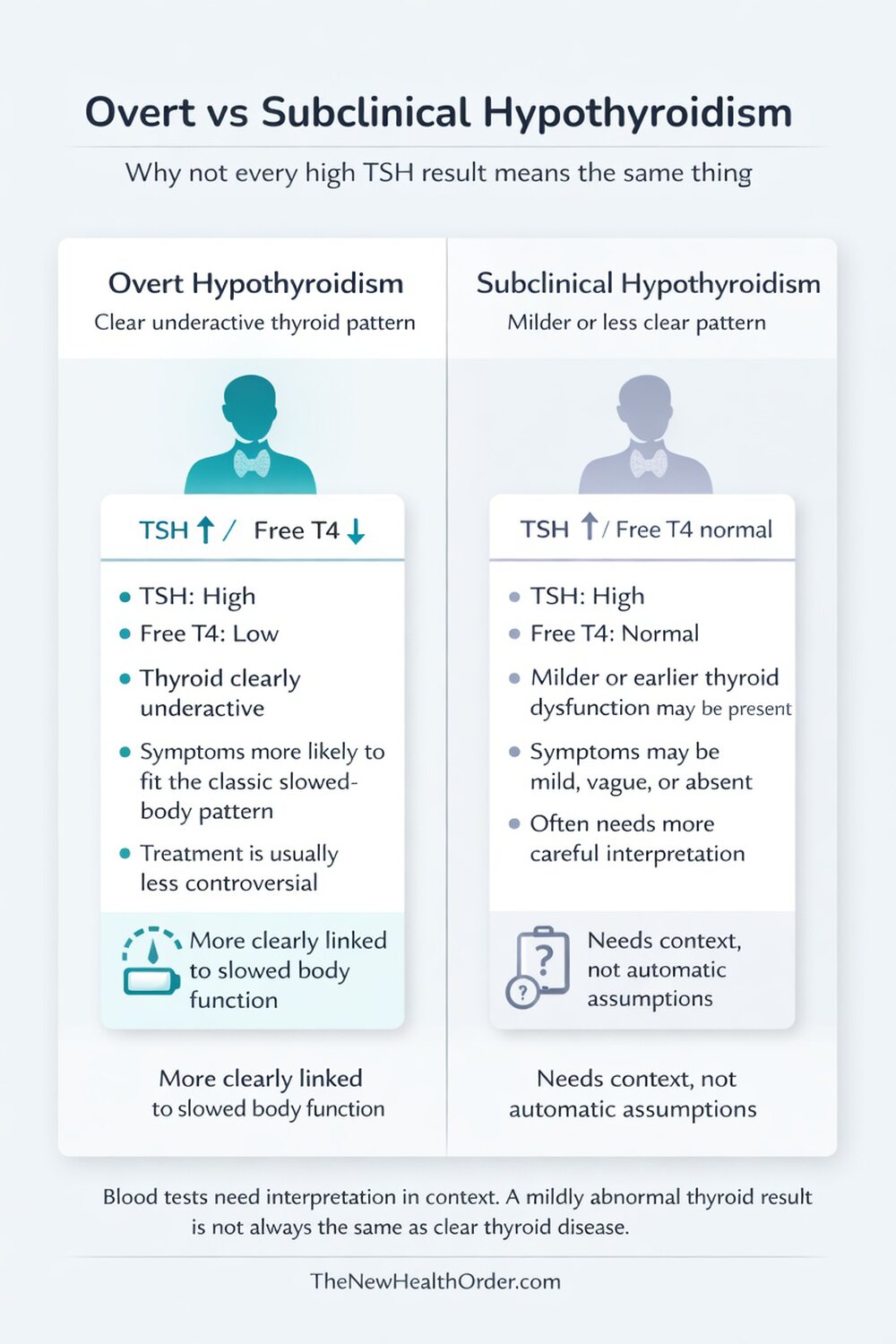
Overt vs Subclinical Hypothyroidism
| Pattern | TSH | Free T4 | What it usually means | Symptom pattern | Usual treatment view |
| Overt hypothyroidism | High | Low | The thyroid is clearly underactive | More likely to fit the classic picture of slowed body function | Treatment is usually much less controversial |
| Subclinical hypothyroidism | High | Normal | There may be mild or early thyroid dysfunction, but the picture is less clear | Symptoms may be mild, vague, or absent | Often needs more careful interpretation rather than automatic treatment |
Overt Hypothyroidism is a Real Metabolic Problem
When doctors talk about overt hypothyroidism, they mean the thyroid is clearly underperforming. In practice, that usually means TSH is elevated and free T4 is low, showing that the body is pushing the thyroid harder but still not getting enough hormone. This is the form of hypothyroidism most clearly linked to the classic pattern of slowed body function, including fatigue, cold intolerance, constipation, dry skin, and some degree of weight gain. It is also the form where treatment is generally much less controversial.
Mild or Subclinical Abnormalities are More Complicated
Subclinical hypothyroidism is different. Here, TSH is elevated, but free T4 is still in the normal range. That can reflect early thyroid dysfunction, but it can also be milder, more temporary, or less clinically important than people assume, especially in older adults, where TSH tends to rise with age. This is one reason a slightly abnormal thyroid result should not automatically be treated as a clear explanation for symptoms.
That distinction matters because the evidence for treatment is not the same. The 2019 BMJ clinical practice guideline issued a strong recommendation against routine thyroid hormone treatment in most adults with subclinical hypothyroidism, based on a systematic review of 21 trials involving 2,192 participants that found no clinically relevant improvement in quality of life or thyroid-related symptoms, including fatigue and body mass index.
The TRUST trial in 737 adults aged 65 and older reached a similar conclusion, finding no meaningful clinical benefit from levothyroxine despite normalization of TSH. The BMJ guideline also noted important exceptions: it did not apply to women trying to become pregnant, patients with TSH above 20 mIU/L, and may not apply to very symptomatic or very young adults.
The practical takeaway is simple: a clearly underactive thyroid is a real metabolic problem, but milder thyroid abnormalities often require more careful interpretation. That makes thyroid testing useful, but it also means that not every borderline result should be treated as a full explanation for fatigue, weight gain, or feeling unwell.
What Thyroid Discussions Often Get Wrong
Thyroid discussions often go wrong in two directions at once. The thyroid is sometimes dismissed as if it barely matters, and at other times inflated into a hidden explanation for almost every problem involving energy, mood, or body weight. The reality is narrower, but also more useful.
Myth: Thyroid problems are a common hidden cause of major weight gain.
Thyroid problems can contribute to weight gain, but usually not on the scale people imagine. The American Thyroid Association notes that for most patients, the amount of weight linked to hypothyroidism is often only around 5 to 10 pounds, and much of that can be due to salt and water retention rather than large fat gain.
Myth: If symptoms improve with thyroid treatment, the thyroid must have been the whole cause.
Symptoms such as fatigue, weight gain, low mood, and feeling cold can occur with thyroid dysfunction, but they are also some of the most common and nonspecific symptoms in medicine. NIDDK explicitly notes that many of these symptoms, especially fatigue and weight gain, do not necessarily mean a thyroid problem is present.
Myth: Free T3 or reverse T3 testing is the key to understanding most thyroid complaints. In standard thyroid assessment, TSH is usually the most useful first test. The American Thyroid Association says T3 testing is often helpful in hyperthyroidism but rarely helpful in hypothyroid patients, and that reverse T3 is not clinically useful in healthy, non-hospitalized people.
Common Signs of a Thyroid Problem
Thyroid problems often show up less as one single obvious symptom and more as a pattern. Because thyroid hormone helps regulate the body’s general pace, changes in thyroid function can affect energy, temperature tolerance, digestion, heart rate, mood, and body weight. The important thing to keep in mind is that these symptoms are common and can overlap with many other issues, which is why they can raise suspicion but cannot confirm a thyroid problem on their own.
Underactive vs Overactive Thyroid: Common Symptom Patterns
| What it can affect | Underactive Thyroid | Overactive Thyroid |
| Overall feel | Slower, heavier, more sluggish | Faster, more restless, more on edge |
| Energy | Tired, low energy | Jittery, overactive |
| Temperature | Feels cold easily | Feels hot easily |
| Weight | Weight gain more common | Weight loss more common |
| Digestion | Constipation | Frequent bowel movements |
| Heart rate | Slower | Faster |
| Mood and focus | Low mood, mental fog | Anxiety, irritability, trouble sleeping |
Signs of an Underactive Thyroid
When the thyroid is underactive, the body often begins to feel as though it is running at a lower speed than normal. A person may feel more tired than usual, feel colder than other people around them, or notice that everyday life seems to take more effort. Dry skin, thinning hair, constipation, a slower heart rate, low mood, and some degree of weight gain can also fit the picture. In women, heavier or more irregular menstrual periods can sometimes be part of it as well.
What makes hypothyroidism tricky is that many of these symptoms are not unique to the thyroid. Fatigue, weight gain, hair changes, and feeling low are extremely common complaints in general, and official guidance is clear that they do not automatically mean a thyroid problem is present. That is why this is one of those areas where symptoms can be a useful clue, but blood testing matters much more than guessing from how you feel alone.
Signs of an Overactive Thyroid
When the thyroid is overactive, the pattern often moves in the opposite direction. Instead of feeling slowed down, a person may feel revved up. Common signs include a racing or irregular heartbeat, feeling hot or sweating more than usual, shakiness in the hands, nervousness, irritability, trouble sleeping, frequent bowel movements, and weight loss even when appetite is normal or increased. Some people also notice muscle weakness, a swelling in the neck from an enlarged thyroid, or changes around the eyes in Graves’ disease.
Even here, the picture is not always straightforward. Hyperthyroidism can sometimes be mistaken for anxiety, stress, or even depression, especially in older adults, where symptoms may look less dramatic or show up differently. So again, the useful takeaway is not that these symptoms prove a thyroid issue, but that they are part of a recognizable pattern worth checking properly when they cluster together.
How Thyroid Problems Are Tested
Doctors usually begin with blood tests rather than symptoms alone, because thyroid symptoms can overlap with so many other issues. Feeling tired, gaining weight, feeling anxious, or running hot or cold can all point toward the thyroid, but none of them are specific enough to rely on by themselves. The purpose of testing is to see whether the thyroid is actually underactive or overactive, and then, if it is, to work out why.
Why TSH is Usually the First Test
TSH is usually the first test because it is the body’s main control signal for the thyroid. It is made by the pituitary gland in the brain and tells the thyroid how much hormone to produce. When thyroid hormone levels start to fall, TSH will often rise in response. When thyroid hormone levels are too high, TSH will usually drop. That makes it a very useful first indicator of whether the system is being pushed too hard or not hard enough.
This is why TSH is often described as an early warning test. It can start to move before the actual thyroid hormone levels have shifted far enough to cause a clear problem on their own. In most healthy people, a normal TSH is a good sign that thyroid function is broadly in the right range, while an abnormal TSH usually tells the doctor that they need to look further.
Common Thyroid Lab Patterns at a Glance
| Pattern | TSH | Free T4 | What it usually suggests |
| High TSH + low free T4 | High | Low | Primary hypothyroidism |
| Low TSH + high free T4 | Low | High | Hyperthyroidism |
| High TSH + normal free T4 | High | Normal | Subclinical hypothyroidism |
| Low TSH + low free T4 | Low | Low | Possible pituitary/central issue |
What Free T4 and Thyroid Antibodies can show
If TSH is abnormal, the next step is often to look at free T4. This helps show how much thyroid hormone is actually available to enter tissues and do its job. A high TSH with a low free T4 points toward primary hypothyroidism, meaning the thyroid itself is not making enough hormone. A low TSH with a high free T4 points more toward hyperthyroidism, where the thyroid is producing too much.
The word “free” matters here because much of the thyroid hormone in the blood is attached to proteins. That bound hormone is being carried around, but it is the free portion that is available to enter tissues. Measuring free T4 gives a cleaner picture of thyroid status, especially in situations where protein levels in the blood may affect total hormone measurements.
Thyroid antibodies are a different kind of test. They do not mainly tell you how much thyroid hormone you have at that moment. Instead, they help show whether the immune system may be attacking or stimulating the thyroid. For example, thyroid peroxidase antibodies or thyroglobulin antibodies can support a diagnosis of Hashimoto’s disease, while TSH receptor antibodies can point toward Graves’ disease. In other words, TSH and free T4 help show what the thyroid is doing, while antibodies can help explain why it is happening.
The simplest way to think about it is this: TSH is usually the starting signal, free T4 helps confirm what direction the thyroid is moving in, and thyroid antibodies can help identify whether an autoimmune condition is behind the problem. That combination gives a much clearer picture than symptoms alone ever can.
The Thyroid Matters, but it is Not the Answer to Everything
The thyroid is one of the body’s real metabolic regulators. When thyroid function is clearly too low or too high, the effects on energy, temperature, and body weight can be meaningful. But those effects are often more specific, and usually less dramatic, than people assume.
That is why the thyroid should be taken seriously without being turned into a catch-all explanation. Symptoms such as fatigue, weight gain, anxiety, low mood, and poor concentration can occur with thyroid problems, but they can also happen for many other reasons. The same is true of body weight. An underactive thyroid can contribute to weight gain, but it rarely explains large changes on its own.
The most useful question is not whether the thyroid matters. It does. The better question is whether it is actually the cause of the problem in front of you, and whether blood testing supports that conclusion. In that sense, the thyroid is best understood as important, sometimes decisive, but never the whole story.
The thyroid is one of the few systems in the body that really can change your metabolic pace. But it is also one of the most overblamed. It can affect energy, body temperature, and weight in real and meaningful ways, yet it is often treated as a catch-all explanation for fatigue, stubborn pounds, and that feeling of just being “off.”
The truth sits somewhere in the middle. The thyroid matters, sometimes a great deal, but it is not the answer to everything, as some make it out to be. In this article, we will look at what the thyroid actually does, how it influences metabolism and energy, how much it really affects body weight, what signs can point to a genuine thyroid problem, and how thyroid issues are properly tested. By the end, you should have a clearer sense of what the thyroid can realistically explain, where people often overstate its role, and how to think about it in a more grounded way.
FAQs
Can thyroid problems really slow your metabolism?
Yes. Thyroid hormones help regulate how quickly the body uses energy. When thyroid function is too low, metabolic pace can slow in meaningful ways.
Does hypothyroidism cause major weight gain?
Usually not. It can contribute to weight gain, but the effect is often modest, and some of the increase may be due to fluid retention.
What is the first test for a thyroid problem?
TSH is usually the first test. If it is abnormal, doctors often look at free T4 and sometimes thyroid antibodies to understand the full picture.