
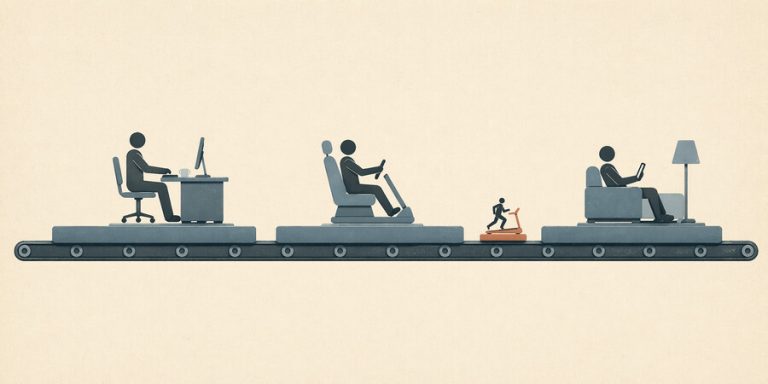
Many people assume that if they exercise regularly, they have covered the movement side of health. Yet plenty of people who run, lift, or go to the gym still feel stiff, tight, sluggish, and oddly restricted in everyday life. Their hips lock up, their backs ache, their posture slips, and over time the effects can go beyond discomfort into poorer blood sugar control, reduced mobility, and a body that feels less capable than it should.
The reason is simple: exercise and movement are not the same thing. A workout matters, but so does the rest of the day, and for many people the rest of the day is built around sitting. For most of human history, regular movement was woven into daily life. Modern life has stripped much of that away, and the body responds to that loss whether you train or not.
This article explains why that matters, what prolonged sitting does to the body, why workouts alone do not fully solve the problem, and how to build more movement back into a desk-based day.
Can Exercise Cancel Out Sitting All Day?
Usually not. Exercise still matters enormously, but it does not completely undo a day built around sitting. That is why public-health guidance now makes both points at once: meet your weekly exercise targets, and also spend less time sitting.
A workout is a strong stimulus, but it is still only one short part of the day. The rest of the day matters just as much. If most of your waking hours are spent sitting, your body is still getting a mostly low-demand signal. That is really the heart of the issue here. Exercise and daily movement are not the same thing, and one does not fully replace the other.
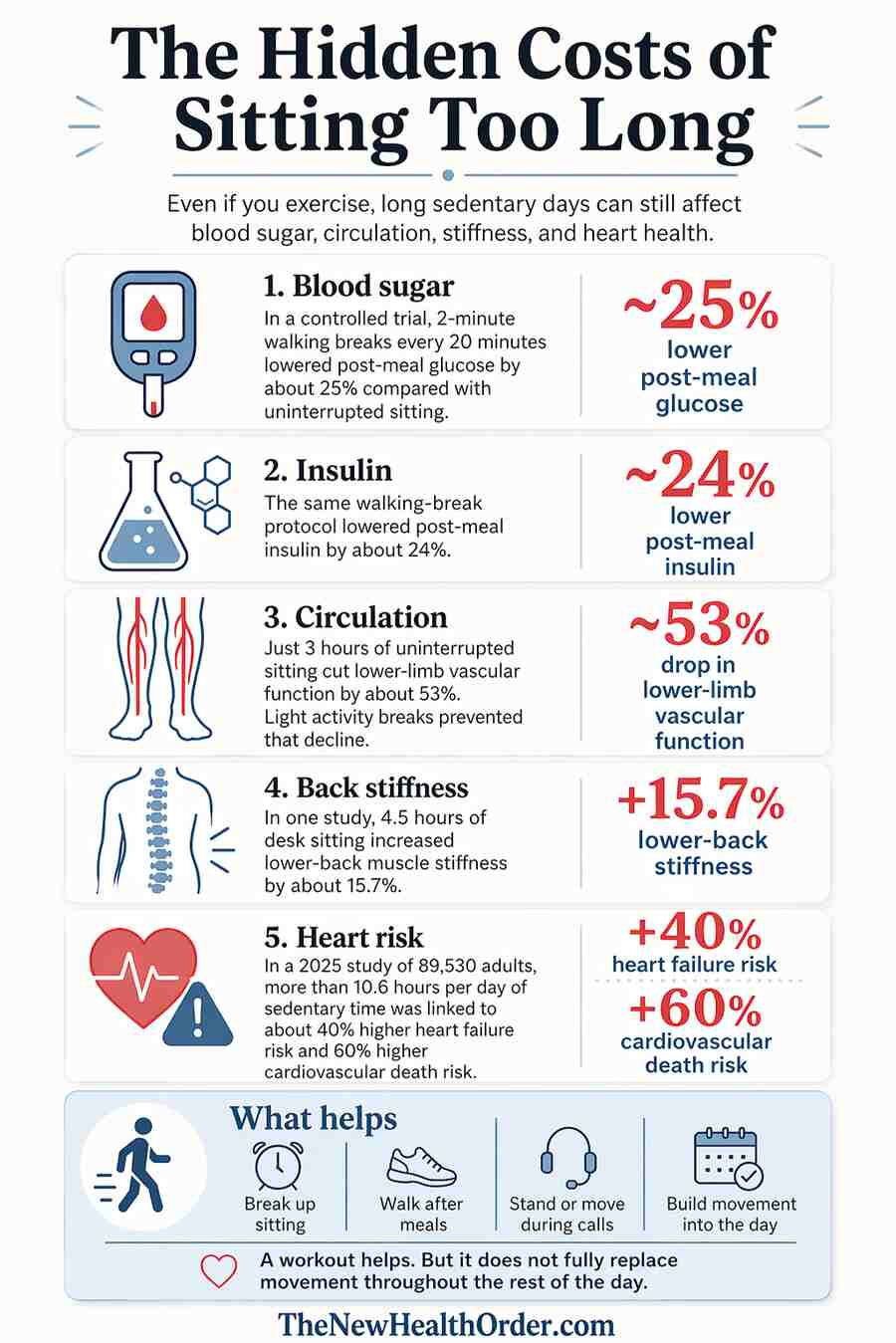
In a 2025 JACC study of 89,530 adults wearing accelerometers, sedentary time above about 10.6 hours a day was linked to sharply higher cardiovascular risk. Compared with the least sedentary group, the most sedentary group had roughly 40% higher risk of heart failure and 60% higher risk of cardiovascular death. Those associations remained even among people who met the usual exercise target of 150 minutes per week of moderate-to-vigorous activity.
So the honest answer is no: exercise helps, often a lot, but it is not a free pass to stay still for the rest of the day. A good workout improves fitness and health. It just should not be expected to carry the whole burden of a sedentary life. That is why the real goal is not just to exercise, but to build more movement into the day around it.
The Difference Between Exercise and Daily Movement
Exercise is one form of movement, but it is not the whole picture. Exercise is usually structured, deliberate, and more intense. It is the run, the lift, the bike session, the class, the workout you plan and set aside time for.
Movement, on the other hand, is the background layer around it: standing, walking, carrying, climbing stairs, changing position, pacing on a call, getting up after meals, and all the small physical tasks that keep the body from settling into long stretches of stillness.
The easiest way to see the difference is to put the three side by side:
| Category | What it looks like | What it helps with | What it does not replace |
| Exercise | Running, lifting, cycling, classes, workouts | Builds strength, fitness, bone health, and cardiovascular capacity | Does not fully replace movement throughout the rest of the day |
| Daily movement | Walking, standing, stairs, post-meal walks, moving during calls, changing position | Keeps muscles active, supports circulation, posture, glucose handling, and general physical function | Does not replace structured exercise |
| Sedentary time | Desk work, driving, prolonged sitting, TV time | Useful for rest and some tasks, but only in moderation | Cannot be fully cancelled out by a workout |
For most of human history, movement was not something people had to schedule for health. It was built into life itself. People walked to get places, carried things, prepared food by hand, cleaned, lifted, climbed, cared for children, and spent far less of the day sitting in one fixed position.
Even much more recently, daily work and household life demanded far more physical effort than modern chair-based life does now. The body evolved in that kind of environment, which means many of its systems work best when regular movement is part of the background of the day, not when activity is compressed into a short workout and the rest of the day is still.
The body is not only responding to the workout. It is responding to the day around it. You can train hard for an hour, then spend the rest of the day sitting at a desk, sitting in the car, and barely using your body at all. In that case, the overall message is still one of low demand. That is why exercise can improve fitness without fully replacing what regular daily movement used to provide.
Exercise builds strength, fitness, and capacity. Daily movement does the quieter work in the background. It keeps muscles active, joints moving, circulation flowing, and the body from settling into long stretches of stillness. Both matter, but they are not interchangeable. The goal is not just to fit in workouts, but to make sure movement still exists across the rest of the day as well.
Get Your Free Book!
Enter your email to get the free book and occasional updates from The New Health Order.
What Happens in the Body When You Sit Too Much
Sitting for long stretches does more than lower calorie burn. It changes the background conditions your body is working under. Muscle activity drops, circulation becomes more sluggish, and tissues are held in the same positions for hour after hour.
None of that is dramatic in the moment, which is part of why the problem is so easy to miss. But over time, the body adapts to what it repeats most. That is why prolonged stillness tends to show up not as one obvious symptom, but as a quieter mix of poorer blood sugar control, stiffness, discomfort, and a body that feels less responsive than it should.
How Prolonged Sitting Affects the Body
| System | What sitting tends to do | What regular movement helps support |
| Blood sugar / muscle activity | Muscles stay idle for long stretches, so meals are often handled less smoothly and blood sugar regulation can worsen | Regular muscle use, better glucose handling, and a more metabolically active background state |
| Circulation | Blood flow becomes more sluggish, especially in the lower limbs, and the body loses some of the pumping effect that comes from regular muscle contraction | Healthier circulation, better vascular function, and more regular tissue perfusion |
| Joints / connective tissue | Joints stay at the same angles for too long, tissues stiffen, and movement range can gradually narrow | Joint motion, tissue loading, synovial fluid circulation, and better overall mobility |
| Posture / stiffness | The body adapts to repeated seated positions, often showing up as tight hips, a stiff upper back, and forward-drifting posture | More regular position changes, better movement variety, and less time fixed in one shape |
| Back discomfort | Prolonged sitting can increase lower-back stiffness and contribute to discomfort over time | More frequent muscular activity, less prolonged loading in one position, and better tolerance to everyday movement |
Blood Sugar and Muscle Activity
One of the simplest ways to understand this is through muscle use. When muscles are being used regularly, even lightly, they help deal with incoming fuel. When they stay idle for hours, meals tend to be handled less smoothly.
In one controlled trial, 19 overweight/obese adults aged 45–65 sat for 5 hours after a test drink, either uninterrupted or with 2-minute walking breaks every 20 minutes. Compared with uninterrupted sitting, the light-walking condition reduced postprandial glucose iAUC by about 25% postprandial insulin iAUC by 24%. Moderate-intensity walking breaks produced very similar reductions.
That matters because modern life often combines frequent eating with long periods of low muscular demand. So the issue is not just that you are “burning less.” It is that the body is spending too much of the day in a state where very little is being asked of it, killing your metabolic flexibility. That is one reason sitting all day can leave people feeling flat and metabolically off even when they do exercise later.
Circulation, Joints, and Posture
Stillness affects more than metabolism. In experimental studies, just 3 hours of uninterrupted sitting cut lower-limb vascular function sharply, with one study showing about a 53% drop over that period. Brief light activity breaks prevented that decline, and a later meta-analysis found the same general pattern across studies. That helps explain why long stretches of sitting can leave people feeling heavy, stagnant, or unusually stiff, even if the effect is easy to miss in the moment.
The same pattern shows up on the musculoskeletal side too. In one 2021 study, 4.5 hours of desk sitting increased lower-back muscle stiffness by about 15.7%. In a related experiment, that effect was prevented when regular muscle contractions were added during the sitting period. More recently, a six-month randomized trial found that cutting daily sitting by about 40 minutes prevented back pain from worsening. That helps explain why long desk-based days so often leave people with tight hips, a stiff upper back, and an achy lower back.
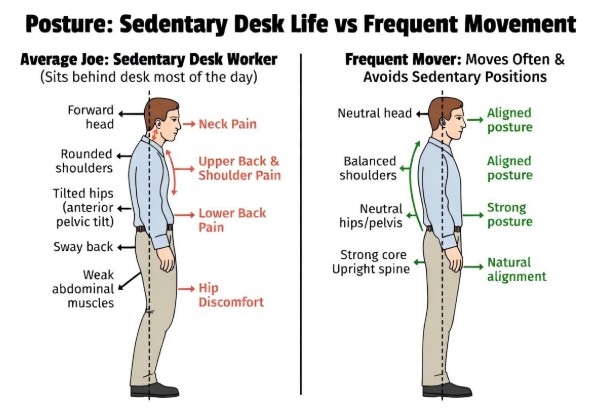
This is why movement matters in a way a single workout cannot fully replace. It is not only exercise that shapes how the body feels and functions, but the repeated pattern of the whole day.
Why One Workout Does Not Fully Replace Movement Throughout the Day
A workout is a concentrated dose of physical stress. That is part of what makes it valuable. It can build strength, improve fitness, and challenge the body in ways ordinary daily movement often does not. But that still does not mean it fully replaces what the rest of the day is doing to you.
The problem is frequency. A workout may last forty-five minutes or an hour, but the body is still responding to everything around it before and after that. If most of the day is spent sitting, commuting, and barely using your muscles, the dominant signal is still low demand. That is why public-health guidance now makes both points together: get regular exercise, and sit less. The two are related, but they are not interchangeable.
The research points the same way. Device-based studies suggest that about 30 to 40 minutes of moderate-to-vigorous activity a day can offset a good deal of the excess mortality risk linked to prolonged sitting. But “offset” is not the same as erase. In newer accelerometer data, people sitting more than about 10.6 hours a day still had markedly higher risks of heart failure and cardiovascular death, even if they were hitting standard exercise targets. Again, exercise helps, but it does not fully replace movement spread through the rest of the day.
How Much Daily Movement Should You Aim For?
There is no perfect number that applies to everyone, and step counts are only a rough proxy for movement. But they are still useful, because they turn a vague goal into something you can actually see.
For most people, a sensible target is not to obsess over 10,000 steps, but to stop spending the whole day barely moving and build toward a daily level that is clearly no longer sedentary. That is the real shift this article is aiming at.
A Practical Daily Step Target
A good practical target for many adults is around 7,000 steps per day. That is not because 7,000 is a magic threshold, but because recent evidence suggests it is enough to be associated with meaningful health benefits across a wide range of outcomes, while also being more realistic than treating 10,000 as the minimum standard.
For example, a 2025 systematic review and meta-analysis concluded that although 10,000 steps can still be a valid goal for more active people, 7,000 steps per day is associated with clinically meaningful improvements in most outcomes, and benefits begin below that level as well.
For example, a 2025 systematic review and dose-response meta-analysis found that, compared with 2,000 steps per day, 7,000 steps per day was associated with a 47% lower risk of all-cause mortality, a 25% lower risk of cardiovascular disease, a 38% lower risk of dementia, and a 22% lower risk of depressive symptoms. Benefits also began below that level, with even around 4,000 steps per day associated with better health than 2,000, while gains for many outcomes started to level off around 7,000 steps.
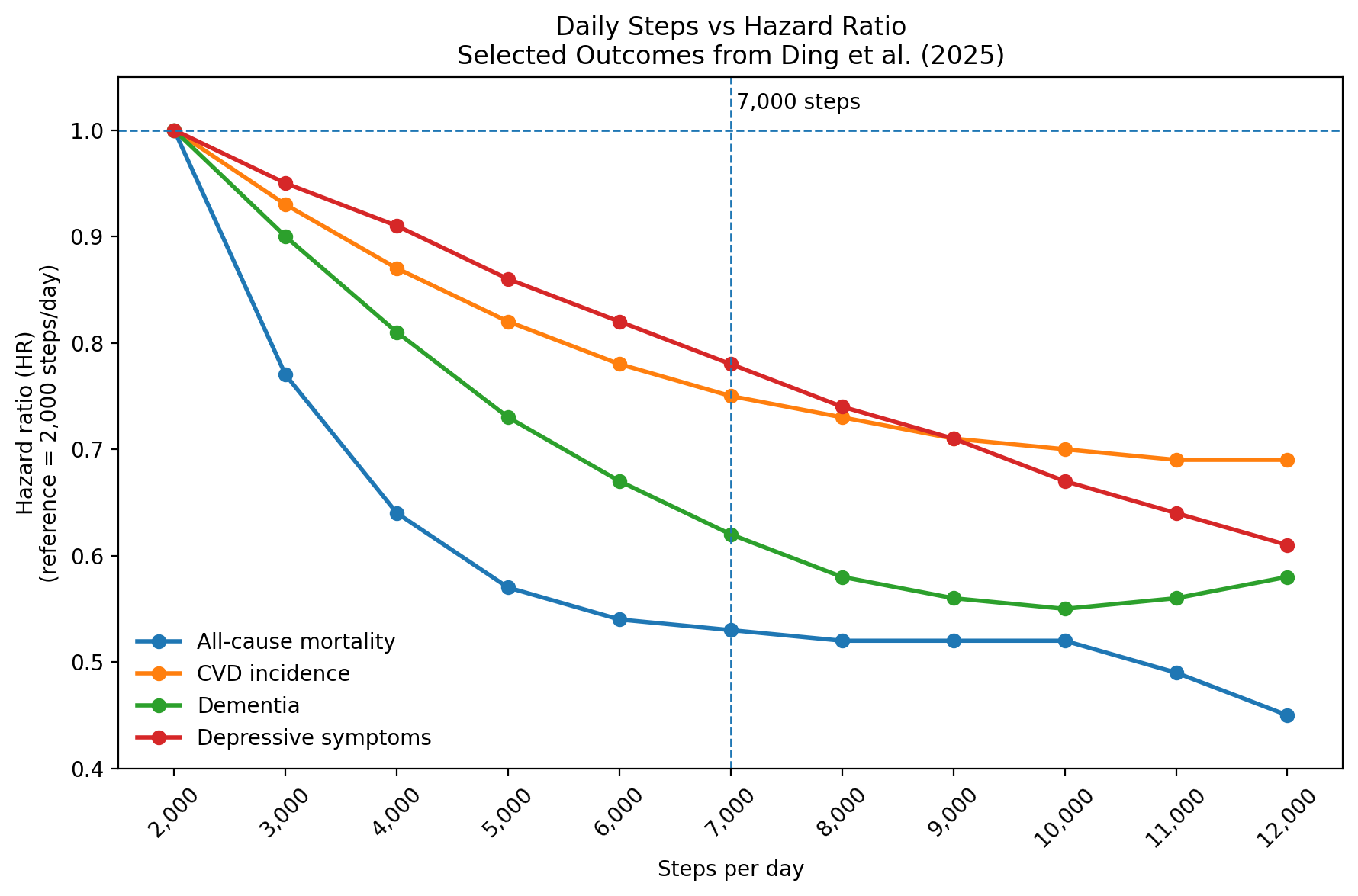
Having a measurable goal helps for another reason too: many people are starting from far less movement than they realise. Tracking steps can be a useful reality check, because it quickly shows how little movement a normal day may actually contain. If someone is only getting 3,000 or 4,000 steps a day, increasing that is already meaningful progress. The aim is not to chase a perfect number, but to raise the baseline enough that movement is no longer missing from the background of the day.
Why Movement Frequency Matters More Than One Long Walk
How movement is spread through the day matters almost as much as the total amount. A long walk in the evening is still worthwhile, but it does not fully undo a day spent sitting almost without interruption.
That shows up in the research too. In one randomized crossover trial, healthy adults had better post-meal glucose and insulin responses when they took very short walking breaks throughout the day than when they did a single 30-minute bout of exercise followed by prolonged sitting. Later review-level evidence has pointed in the same direction: breaking up sedentary time with brief activity improves post-meal glucose and insulin handling, with breaks every 30 minutes or less appearing especially effective.
See this article here for a deeper dive into the importance of insulin for metabolic health.
That is why daily movement is not just about reaching a step total by the end of the day. It is also about avoiding long blocks of stillness. Short walks, standing breaks, and regular changes in position may seem minor on their own, but spread across the day they do something a single catch-up walk cannot fully replace: they keep the body active often enough that sitting does not become the default state.
How to Add More Movement to a Sedentary Day
The goal here is not to turn a workday into a workout plan. It is to stop letting the whole day disappear into stillness. Of course, real life places limits on what people can do. Many people have desk jobs, long meetings, commutes, deadlines, childcare, and working environments where they cannot simply get up and take a walk every hour. That is exactly why this is such a common problem.
But those limits do not make movement unimportant. They just mean the answer has to be practical. The aim is to make movement small, frequent, and tied to things that already happen anyway, while being as creative as your day allows. Less heroics, more built-in movement.
Short Walking Breaks
Short walking breaks are one of the simplest ways to break up a sedentary day. They do not need to be long or intense to matter. Even a couple of minutes every hour, or a minute or two every 30 minutes when that is realistic, can help blunt some of the effects of prolonged sitting. In controlled trials, brief walking breaks taken throughout the day improved post-meal glucose and insulin responses compared with uninterrupted sitting, and pooled evidence points in the same direction.
The point is not that everyone must get up on a perfect schedule. Many people cannot. It is that long, uninterrupted blocks of sitting are part of the problem, so regularly breaking them up is part of the solution. A quick lap around the office, a walk to refill water, a trip upstairs, or even a short walk between tasks may seem minor, but done consistently they stop stillness from dominating the whole day.
Standing and Moving During Calls
Phone calls can be a useful movement anchor because they do not require extra time, only a different use of time you already have. For some people, that may mean standing up, pacing the room, or walking while they talk. This has the added benefit of creating a habit based on anchoring (the phone call), so it’s easier to remember and will soon become automatic.
For others, especially in call centres or tightly monitored desk roles, the options may be more limited. In that case, the aim is simply to introduce whatever movement is realistically possible, whether that means standing for certain calls, changing position more often, or using short gaps between calls to move briefly. None of this is dramatic, but it helps break the pattern of staying in the same posture for hours.
Walking After Meals
If there is one habit here that gives a lot back for very little effort, it is a short walk after meals. It does not need to be a power walk, and it does not need to feel like a second workout. The value is mostly in the timing.
A 2023 systematic review and meta-analysis pooled 8 randomized crossover trials, covering 30 interventions in 116 participants, and found that exercise performed after a meal lowered post-meal glucose more than both pre-meal exercise and no exercise. Compared with no exercise, the pooled effect size was 0.55, and compared with pre-meal exercise it was 0.47.
The same review also found that the longer people waited after eating, the smaller the benefit became, which is why a brief walk soon after a meal often works better than saving all your movement for later in the day.
Using Your Environment to Increase Movement
This is usually less about motivation than setup. If the day is arranged in a way that keeps everything within arm’s reach, movement tends to disappear without you noticing. So it helps to make small changes that nudge you out of the chair more often: keep water farther away, take the longer route to the bathroom or printer, stand for low-focus tasks, walk over to speak to someone when it is practical, park further away in the parking lot, or use the stairs instead of the elevator. Even small things like shifting position more often, standing at your desk for part of the day, or fidgeting a little more are better than staying completely still for hours.
Some people can also make use of a standing desk, an improvised standing setup, or even an under-desk pedal machine if their job keeps them tied to one station. None of this is dramatic, but that is exactly why it works. The more movement is built into the structure of the day, the less you have to rely on remembering, negotiating, or forcing yourself to do it. Over time, that is often what makes the difference: not one heroic effort, but a day that no longer makes stillness the easiest option.
Why Exercise Still Matters for Health and Fitness
None of this means exercise is optional, or that simply moving around more can replace training. Regular exercise still has its own distinct value. Current guidelines continue to recommend at least 150 minutes of moderate aerobic activity a week, or 75 minutes of vigorous activity, along with muscle-strengthening work on two or more days per week. That is not because exercise is a luxury on top of movement, but because it improves health in ways ordinary background activity often does not.
Strength training is a good example. People often think of it mainly in terms of building muscle or looking better, but its effects go well beyond that. It helps preserve and build muscle mass, which matters for strength, physical function, and resilience as we age.
It also supports bone health which is vital as we age because stronger muscles and stronger bones make the body less fragile. In older adults especially, exercise is linked with better function, fewer falls, and a lower chance of serious fall-related injury.
Resistance training also loads tendons and other connective tissues, which adapt over time; a 2022 systematic review and meta-analysis found that mechanical loading, especially resistance training, increased tendon stiffness, modulus, and cross-sectional area. And while “perfect posture” is not really the goal, strengthening does seem to improve some postural imbalances better than stretching alone, particularly in the thoracic and cervical spine.
Aerobic exercise matters for a different reason. It improves cardiorespiratory fitness—the capacity of the heart, lungs, circulation, and muscles to deliver and use oxygen well during activity. That may sound technical, but in practice it means better endurance, better work capacity, and a cardiovascular system that is under less strain.
It is also one of the clearest predictors of long-term health. A 2024 overview of meta-analyses concluded that cardiorespiratory fitness is a strong and consistent predictor of morbidity and mortality in adults. More broadly, regular aerobic activity is linked with lower risk of heart disease, stroke, type 2 diabetes, high blood pressure, and depression, while also improving sleep and helping with blood-pressure control.
So the point of this article is not to downplay exercise, but to put it in the right place. Daily movement keeps the body from spending the rest of the day in a low-demand state. Exercise builds capacity on top of that. Strength training helps you keep muscle, bone, connective tissue, and functional robustness. Aerobic training builds cardiovascular fitness and metabolic health. You want both. A healthy day is not built from movement alone, and it is not built from workouts alone either.
The Best Approach: Combine Regular Exercise With More Daily Movement
The real mistake is to assume that a few workouts a week automatically add up to an active lifestyle. They do not. Even exercising every day does not fully offset a day built around sitting. A workout is still only one part of the picture, and the body is responding to everything that happens outside it as well.
Regular exercise still matters enormously. It builds strength, fitness, resilience, and capacity. But daily movement does something different. It keeps the body from spending the rest of the day in a prolonged low-demand state, and that is the part modern life has quietly stripped away.
So the goal is not just to work out. It is to build a day where movement is present throughout. Lift weights. Do your cardio. Train on purpose. But also make sure the day itself includes regular standing, walking, shifting position, and short bouts of movement that stop stillness from dominating everything in between.
That is the practical takeaway from this whole article. Do not mistake workouts for a fully active life. Aim for both: structured exercise to build capacity, and regular daily movement to provide the background your body still expects.
FAQs
How many steps a day should you aim for?
For many adults, around 7,000 steps per day is a practical target. In the 2025 meta-analysis, compared with 2,000 steps, 7,000 steps was associated with a 47% lower all-cause mortality risk, 25% lower cardiovascular disease incidence, 38% lower dementia risk, and 22% lower depressive symptoms. Benefits begin below that, but for several outcomes the curve starts to flatten around 5,000 to 7,000 steps.
What is the best way to move more during a desk-based day?
Do not rely on willpower. Build movement into things that already happen: short walking breaks, standing or moving during calls, walking after meals, taking the longer route, and setting up your environment so getting up happens more often. The goal is not perfection. It is to stop long, uninterrupted sitting from dominating the day.
Can you still be sedentary if you exercise every day?
Yes. A workout improves fitness, but it does not automatically make the rest of the day active. If most of your waking hours are still spent sitting, the dominant pattern is still low movement. That is the core mistake this article is trying to correct: workouts do not equal an active lifestyle.