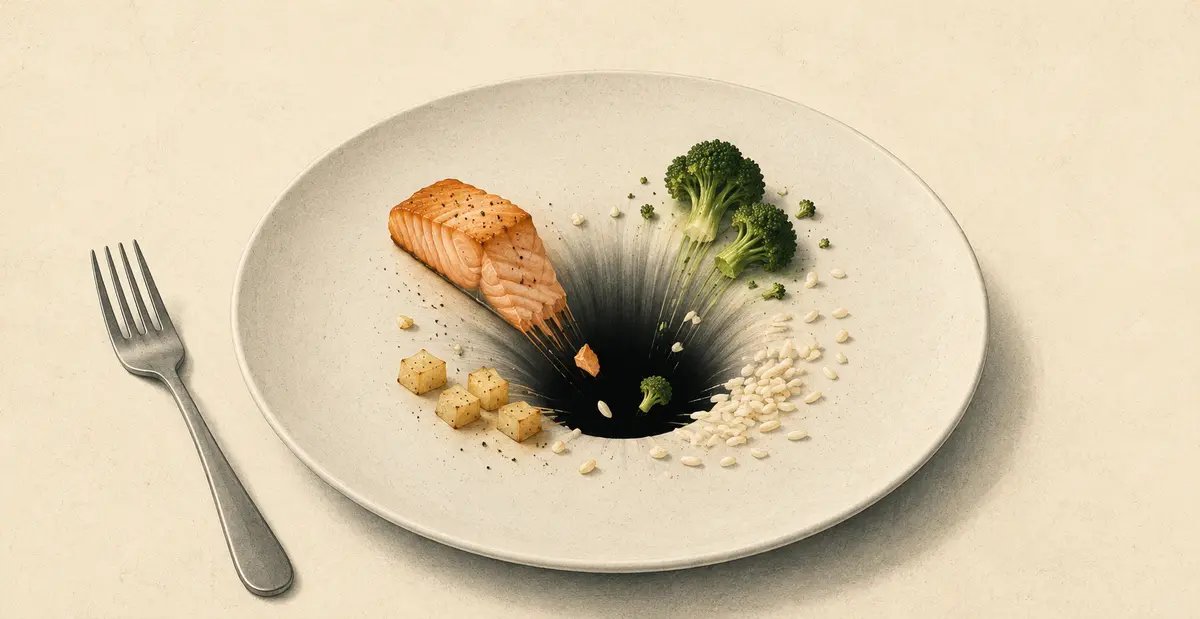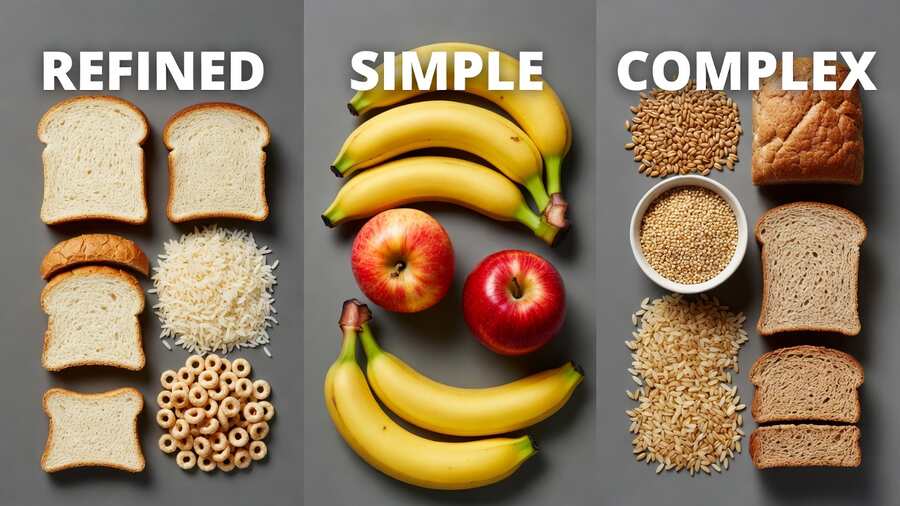
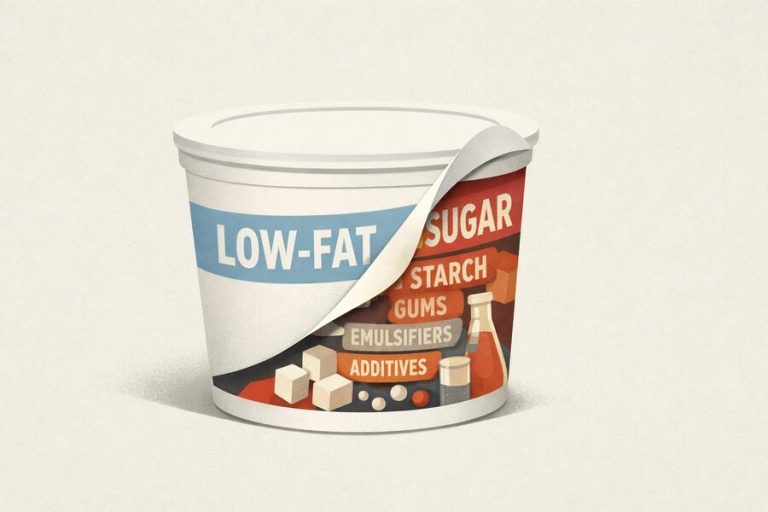
Low-fat diets were sold as one of the safest and most sensible ways to eat. The logic seemed obvious: cut fat, protect your heart, and improve your health. But once low-fat advice reshaped the food supply and was tested in major studies, the story became much less convincing.
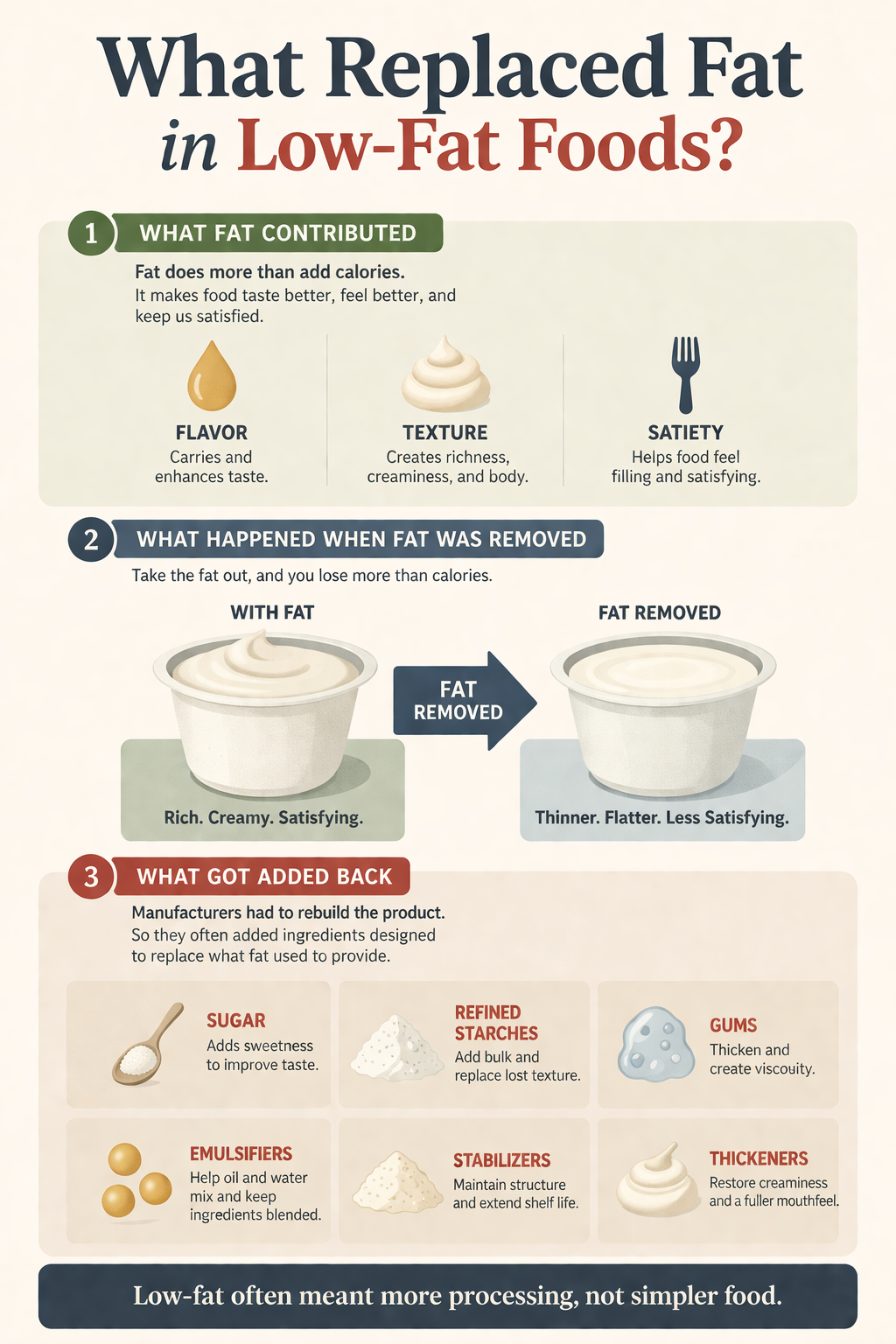
One reason is that removing fat did not simply make food healthier. In many cases, it made food more processed. When fat came out, it was often replaced not with more whole foods, but with sugar, refined starches, gums, thickeners, emulsifiers, and other additives designed to restore texture, flavor, and shelf life. On the label, it still looked like the healthier choice, even though the food itself had often become more processed and less satisfying.
The other problem is that the promised health benefits never showed up as clearly as expected. Large trials did not show strong cardiovascular advantages for low-fat diets, and when low-fat was compared directly with Mediterranean and low-carbohydrate diets, it often failed to come out ahead.
This article explains what low-fat advice got wrong, how low-fat foods were often rebuilt with more processed ingredients, why those replacements were often worse than the original foods, and why the science never delivered the clear health improvements that were promised.
Why Low-Fat Diets became so Popular
Low-fat diets caught on because the mainstream narrative pushed to us was easy to believe. If fat increased cholesterol, and cholesterol increased heart disease risk, then eating less fat sounded like a straightforward way to stay healthy.
To see why this was a vast oversimplificaiton and what the science actually reveals about cholesterol, see this article here.
It also gained force from a simple confusion: people heard “fat” in food and “fat” on the body and assumed the connection was straightforward. That made low-fat advice feel obvious before it had really been proven.
That message became much more powerful once it was built into official guidance. In 1980, the first Dietary Guidelines for Americans told people to “avoid too much fat, saturated fat, and cholesterol.” Then the 1990 Nutrition Labeling and Education Act standardized claims such as “low,” “free,” and “reduced,” turning low-fat from a general recommendation into a front-of-package marketing tool. “Low-fat” was now easy to measure, easy to regulate, and easy to sell.
The food market responded quickly. USDA tracking showed that low- and no-fat claims rose from 9.2 percent of new products in 1989 to more than 25 percent by 1995–1996. Another analysis found that more than 3,400 low-fat and fat-free products were introduced during the 1990s. This was no small dietary trend—it was a large-scale reshaping of the food environment.
At the population level, the diet shifted in the expected direction, at least on paper. NHANES data show that from the early 1970s to 1999–2000, the percentage of calories from fat fell while carbohydrates rose. Traditional higher-fat staples declined too. Whole milk, for example, dropped from 25.3 gallons per person in 1970 to 5.4 gallons by 2012. By then, low-fat was not simply a recommendation. It had become the default model of what healthy eating was supposed to look like.
What Replaced Fat
Removing fat did not simply lower the fat content of food. It changed how food tasted, how filling it felt, and how products had to be made. To understand why the low-fat era went wrong, it helps to look at both what was lost when fat was removed and what was used to replace it.
Fat was Removed, But Satisfaction Went With It
One of the biggest problems with low-fat eating is that fat does far more in food than simply add calories. It carries flavor, shapes texture, and gives meals a sense of richness and completeness that refined carbohydrate does not replace very well.
It also appears to contribute to satiety, helping meals feel substantial enough that eating comes to a natural stop. Once fat was stripped out, much of that satisfaction went with it. Food could still look acceptable on paper, but it often became thinner, less filling, and less rewarding to eat.
That created a practical problem for the food industry. If fat was now something to remove, how do you keep food creamy, stable, and appealing without it? The answer was rarely to replace fat with more real food. More often, it meant reformulating products so they could still deliver the texture, mouthfeel, and palatability people expected. In other words, low-fat rarely meant simpler food. It usually meant engineered replacement.
The Low-Fat Swaps Were Worse
When fat came out, something had to take its place. In practice, that was often sugar, refined starch, and a growing list of additives that could rebuild what fat had once provided naturally. Sweeteners helped soften the taste. Starches and maltodextrin added body. Gums and thickeners recreated viscosity. Emulsifiers and stabilizers helped products hold together. Flavor systems and extra salt helped make the finished product feel less flat.
You can see this clearly in the difference between traditional foods and their low-fat versions. Mayonnaise no longer looks like oil, egg yolk, and vinegar, but more water, starches, gums, sweeteners, and emulsifiers. Yogurt often loses richness, then gains sugar, thickeners, and flavoring to compensate. Salad dressings become more water-based and depend on starches and gums to imitate body. Even ice cream can end up with less cream but more sugar and stabilizers to recreate creaminess. The result was not just a lower-fat version of the same food but often a fundamentally reformulated product.
This is why the low-fat era changed more than the macronutrient profile of the diet. It changed the way food was made. Simpler foods increasingly gave way to longer ingredient lists, while many traditional fats were displaced by refined carbohydrates, industrial oils, and additives designed to restore texture and shelf life.
On the label, the product looked healthier because the fat had been reduced. In practice, the food was often less satisfying, easier to overeat, and further removed from the whole-food version it had replaced.
Traditional Foods vs Low-Fat Reformulations
| Food | Traditional Version | Low-Fat / Fat-Free Reformulation |
| Mayonnaise | Oil, egg yolk, vinegar or lemon, salt | Less oil, more water, starch or maltodextrin, gums, sweeteners, and emulsifiers to rebuild thickness and mouthfeel |
| Yogurt | Milk and live cultures | Less fat, more sugar, starches or thickeners, and flavoring to replace richness and soften sourness |
| Salad dressing | Oil, vinegar, herbs, spices | Often water-based, with sugar, starches, and gums added to mimic body and viscosity |
| Ice cream | Cream, sugar, sometimes egg | Less cream, more sugar, plus stabilizers and emulsifiers to imitate creaminess |
Get Your Free Book!
Enter your email to get the free book and occasional updates from The New Health Order.
Did Low-Fat Diets Improve Health Outcomes?
This is really where the low-fat idea had to prove itself. If reducing fat was the key step toward better health, then large trials should have shown clear improvements in the outcomes people care about most: fewer heart attacks, fewer strokes, and better long-term weight control. But when low-fat diets were tested in major real-world studies, and against other real diets, the results were much less impressive than the public message had suggested.
Large Trials Did Not Show Clear Benefits
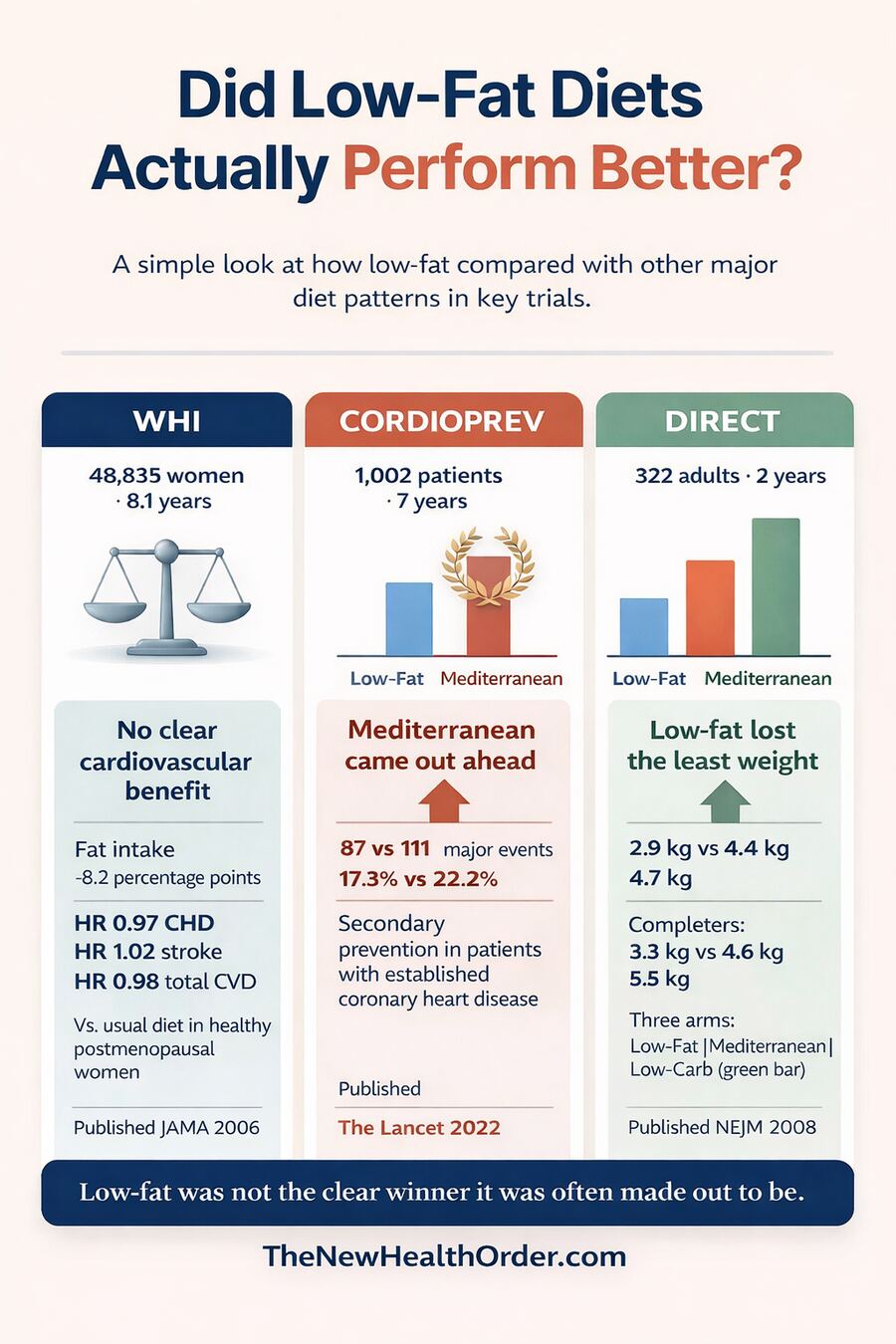
The clearest large-scale test was the Women’s Health Initiative Dietary Modification Trial, which randomized 48,835 postmenopausal women and followed them for an average of 8.1 years. The intervention group ate less fat and more fruits, vegetables, and grains. By year 6, their fat intake was 8.2 percentage points lower than the comparison group.
Yet the outcomes that mattered most barely moved. The hazard ratio (a way of measuring relative risk over time) was 0.97 for coronary heart disease, 1.02 for stroke, and 0.98 for total cardiovascular disease, which is essentially a neutral result. In other words, even in a huge trial with years of follow-up, a low-fat dietary pattern did not produce any noticeable cardiovascular protection many people had been led to expect.
That makes the result even more notable. This was not a case of people simply eating less fat while everything else stayed the same. They also increased vegetables, fruits, and grains, yet the study still found no significant improvement in cardiovascular outcomes. That does not prove the low-fat approach cancelled out the benefits of those changes, but it does weaken the idea that low-fat eating was inherently protective.
Low-Fat vs Mediterranean
Head-to-head comparisons of other “healthy” diets also failed to make low-fat look superior. In the CORDIOPREV trial, 1,002 patients with established coronary heart disease were randomized to either a Mediterranean diet or a low-fat diet and followed for 7 years.
The Mediterranean group had fewer major cardiovascular events: 87 compared with 111 in the low-fat group. Depending on the adjustment model used, the Mediterranean diet was associated with roughly a 25% to 28% lower risk of the primary endpoint, and the authors concluded that the Mediterranean diet was superior to the low-fat diet for secondary cardiovascular prevention.
That is an important comparison, because low-fat was not being tested against obvious junk food. It was being tested against another serious, health-conscious dietary pattern. And when that happened, low-fat did not come out ahead.
This does not prove Mediterranean is best for everyone. It does, however, make the low-fat model look far less convincing than it once did.
Low-Fat vs Low-Carb
A similar pattern appeared in the DIRECT trial, which compared low-fat, Mediterranean, and low-carbohydrate diets in 322 moderately obese adults over 2 years. Mean weight loss was 2.9 kg in the low-fat group, compared with 4.4 kg in the Mediterranean group and 4.7 kg in the low-carbohydrate group.
Among participants who completed the full trial, the gap widened further: 3.3 kg on low-fat, 4.6 kg on Mediterranean, and 5.5 kg on low-carbohydrate. So even for one of the main promises attached to low-fat eating, namely better weight control, it was not the standout winner.
The metabolic results were not especially flattering to low-fat either. The low-carbohydrate group showed the greatest improvement in the ratio of total cholesterol to HDL cholesterol, while among participants with diabetes, the Mediterranean diet produced more favorable fasting glucose and insulin changes than the low-fat diet.
In other words, low-fat was not the strongest option for weight loss, and it was not the strongest option for metabolic health either, compared to low-carb and mediterranean diets, which include plenty of fats.
| Trial | Compared Diets | Participants / Duration | Main Result | Takeaway |
| Women’s Health Initiative | Low-fat vs comparison diet | 48,835 women / 8.1 years | No significant improvement in CHD, stroke, or total CVD | Large low-fat trial did not show clear cardiovascular benefit |
| CORDIOPREV | Low-fat vs Mediterranean | 1,002 patients / 7 years | Mediterranean had fewer major cardiovascular events | Low-fat did not beat another heart-healthy pattern |
| DIRECT | Low-fat vs Mediterranean vs low-carb | 322 adults / 2 years | Low-fat lost the least weight; low-carb and Mediterranean performed better on key measures | Low-fat was not the strongest option for weight loss or metabolic outcomes |
Why Fat Still Matters
Even after the low-fat era lost much of its old certainty, dietary fat was still often discussed mainly as something to limit. But fat is not just a source of calories. It also plays basic roles in nutrient absorption, cell structure, and normal physiology, which is one reason why pushing it down too aggressively was always too simplistic.
Fat and Nutrient Absorption
One reason fat still matters is that some nutrients depend on it for absorption. Vitamins A, D, E, and K are fat-soluble, which means dietary fat helps the body absorb and use them properly.
The same is true for carotenoids in vegetables. In one controlled study, salads eaten with fat-free dressing produced essentially no measurable carotenoid absorption, whereas adding fat increased absorption substantially. So it is possible to do everything that looks healthy on paper, eat the vegetables, choose the fat-free option, and still get less nutritional value from the meal because the fat needed for absorption is missing.
Fat also supplies essential fatty acids that the body cannot make from scratch. Linoleic acid (LA) and alpha-linolenic acid (ALA) have to come from the diet, which is why official reference standards set minimum intake targets for them.
And when fat intake falls low enough for long enough, the consequences are not theoretical. Signs of essential fatty acid deficiency can appear within weeks in adults receiving fat-free parenteral nutrition, then improve when essential fats are added back. Even mainstream guidance acknowledges that fat intake can be set too low, which is why the Dietary Reference Intakes place adult fat intake in the range of roughly 20 to 35 percent of calories.
Fat in Real Food
That does not mean the goal is simply to eat more fat in any form. It is also worth being clear that “fat” is not a single uniform thing. Saturated, monounsaturated, polyunsaturated, and trans fats differ in structure, function, and food sources, so they should not be treated as though they all behave the same way. That distinction matters, but even before getting into the different types of fat, it is already clear that fat in whole foods is not the same dietary exposure as fat in ultra-processed products.
The more important question is what kind of food that fat is coming in. Fat from foods like eggs, meat, full-fat dairy, olives and olive oil, avocados, nuts, and seafood comes packaged with protein, vitamins, minerals, and a food structure the body is better equipped to handle. That is very different from fat consumed through pastries, fried fast food, chips, and other ultra-processed products, where it often comes alongside refined starches, sugars, additives, and heavily processed oils.
This is an important distinction, because nutrition discussions often treat fats as though they all arrive in the same context. But fat in a whole food is not nutritionally equivalent to fat in a heavily processed product. Once fat is bundled together with refined carbohydrates, industrial processing, and long ingredient lists, the health effects of the overall food can look very different. The same problem has shaped the way saturated fat is often discussed. Saturated fat got much of its bad reputation from being grouped together with processed foods and poor dietary patterns, even though saturated fat in foods like dairy, eggs, and unprocessed meat is not the same exposure as saturated fat in pastries, fast food, and ultra-processed snacks.
This is one of the ways the low-fat era went wrong. It treated fat itself as the problem, rather than asking what kind of food was being changed in the first place. Removing fat from real food and replacing it with industrial substitutes does not automatically make a diet healthier. In many cases, it simply creates a product that is more processed and less satisfying. The real goal is not to push fat higher or lower in isolation, but to get all macronutrients, including fat, mostly from whole or minimally processed foods.
What Matters More Than Low-Fat
The low-fat era was built on a simple idea that once seemed settled: fat raises cholesterol, cholesterol drives heart disease, so eating less fat should improve health. But that chain of reasoning has not held up as cleanly as it was once presented, and as the science around cholesterol and heart disease has become less certain, the low-fat message has looked weaker with it.
That matters because once the focus shifted to removing fat as a goal in itself, foods could appear healthier on paper while becoming more processed, less satisfying, and further removed from the whole-food versions they replaced.
That is why the more important question is not simply whether a food is high or low in fat. It is what kind of food the fat is coming in, and what replaces it when that fat is removed. Fat from eggs, meat, dairy, olives, avocados, nuts, and seafood does not mean the same thing in practice as fat arriving through fried fast food, pastries, ultra-processed snacks, and repeatedly heated industrial oils.
In the same way, removing fat from real food is not automatically beneficial if the replacement is more refined carbohydrate, more sugar, more additives, and a product that is easier to overeat.
That is why the real goal is not simply more fat or less fat. It is better food. Ideally, all macronutrients, including fat, should come mostly from whole or minimally processed foods, where they arrive in a more natural food matrix rather than as part of something engineered for shelf life, palatability, and overconsumption.
Once you look at the issue that way, the weakness of the low-fat message becomes much easier to see. The problem was never fat in isolation. It was the dietary pattern created when fat was pushed down and poorer replacements rose to take its place.
FAQs
Are low-fat diets healthy?
Not necessarily. Many low-fat foods became more processed, and large trials did not show the clear health benefits low-fat advice was expected to deliver.
Why were low-fat foods often more processed?
Because once fat was removed, manufacturers often had to add sugar, starches, gums, thickeners, and emulsifiers to restore texture, flavor, and shelf life.
Did low-fat diets perform better than Mediterranean or low-carb diets?
Not in the major trials covered here. Low-fat did not show clear cardiovascular advantages, Mediterranean came out ahead in CORDIOPREV, and low-fat lost the least weight in DIRECT.